Emergency Vehicles: How to Respond When You Hear a Siren
Sooner or later, every driver in Singapore hears a siren approaching a fire engine, an ambulance, or a police car on an emergency call. The BTT tests this scenario in several forms, and many candidates lose marks simply because they assume the rule only applies when the vehicle is directly behind them. It doesn't.
The General Rule
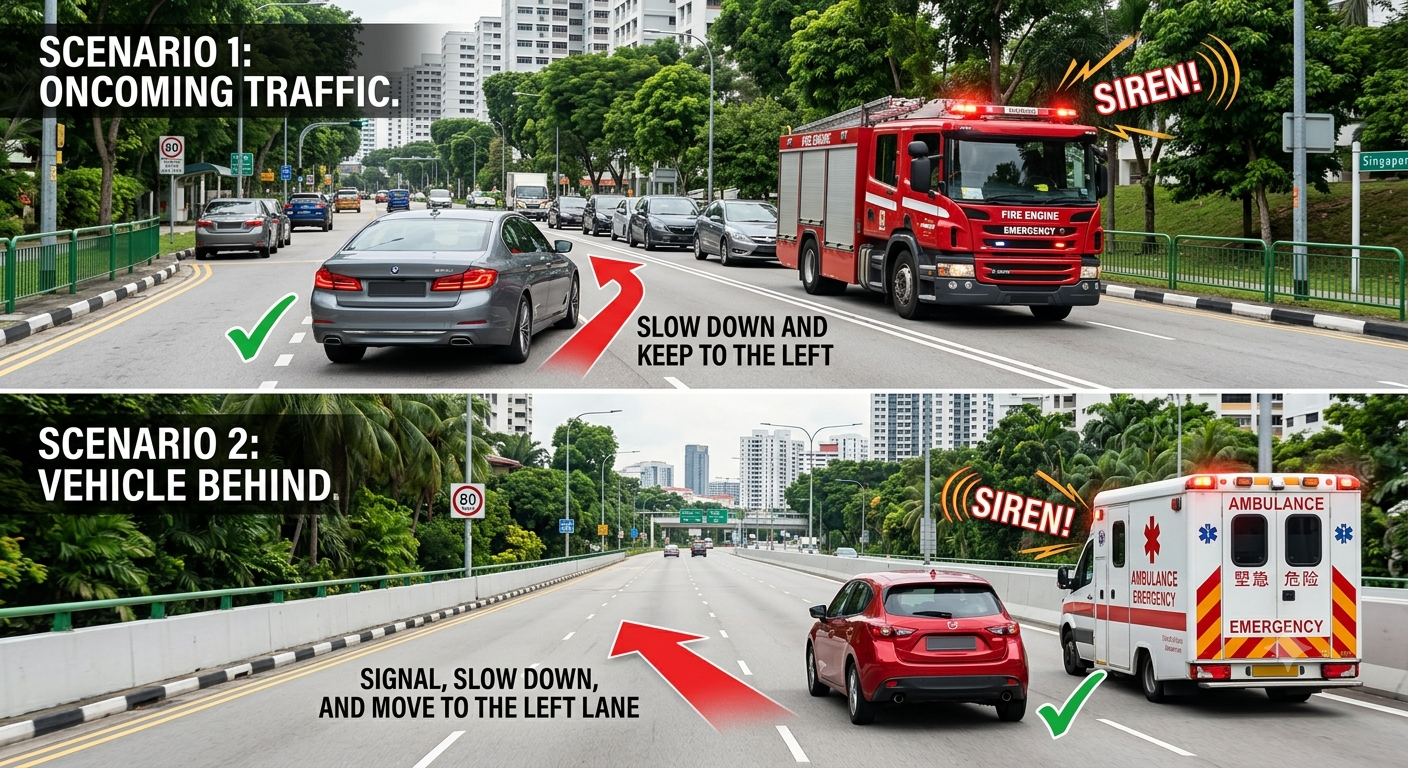
Whenever you hear a siren or see flashing lights from an emergency vehicle whether it's approaching from behind, ahead, or even from the opposite direction you should slow down and keep to the left, stopping if necessary to let it pass safely.
Common BTT Scenario: Siren From Oncoming Traffic
You hear a fire engine siren approaching from oncoming traffic. You should:
🎉 New Community🤝Need Help or Have Test Tips to Share?
Our official forum is now open! Ask questions about tricky BTT/FTT rules, share your driving test experiences, or help fellow learners pass on their first try.
Visit Community Forum → Free & open to all learners
- Slow down and keep to the left
- Stop immediately
- Maintain your speed, as you are not in its way
Correct answer: Slow down and keep to the left.
Even if the emergency vehicle is on the opposite side of the road, it may need to swing into your lane to overtake stopped or slow-moving traffic ahead of it. Other drivers around you may also brake suddenly or swerve to give way. Slowing down and moving left gives everyone including you more room to react safely.
Why "maintain your speed, as you are not in its way" is wrong
This answer assumes the road situation will stay the same, which is exactly the wrong mindset near an emergency vehicle. Conditions change quickly: the fire engine may cross into your lane, or a car near you may brake unexpectedly. Assuming you're "not in its way" removes your margin for reacting safely.
Why "stop immediately" is wrong
An abrupt stop especially with no clear reason from the driver behind you increases the risk of being rear-ended. Unless you're already very close to the vehicle or a junction is involved, gradual slowing and moving left is safer and more predictable for other road users.
What If the Emergency Vehicle Is Behind You?
The same core principle applies: slow down, signal if needed, and move as far left as safely possible to clear a path. Do not panic-brake in the middle of the lane, and never speed up to "beat" the emergency vehicle to a junction.
Key Takeaway for BTT Candidates
Whatever direction the siren is coming from, the safe response is almost always the same: slow down, keep left, and be ready to stop. The BTT often tests whether you understand that giving way to emergency vehicles isn't limited to "vehicles directly behind me" it's a general awareness rule that applies from any direction.