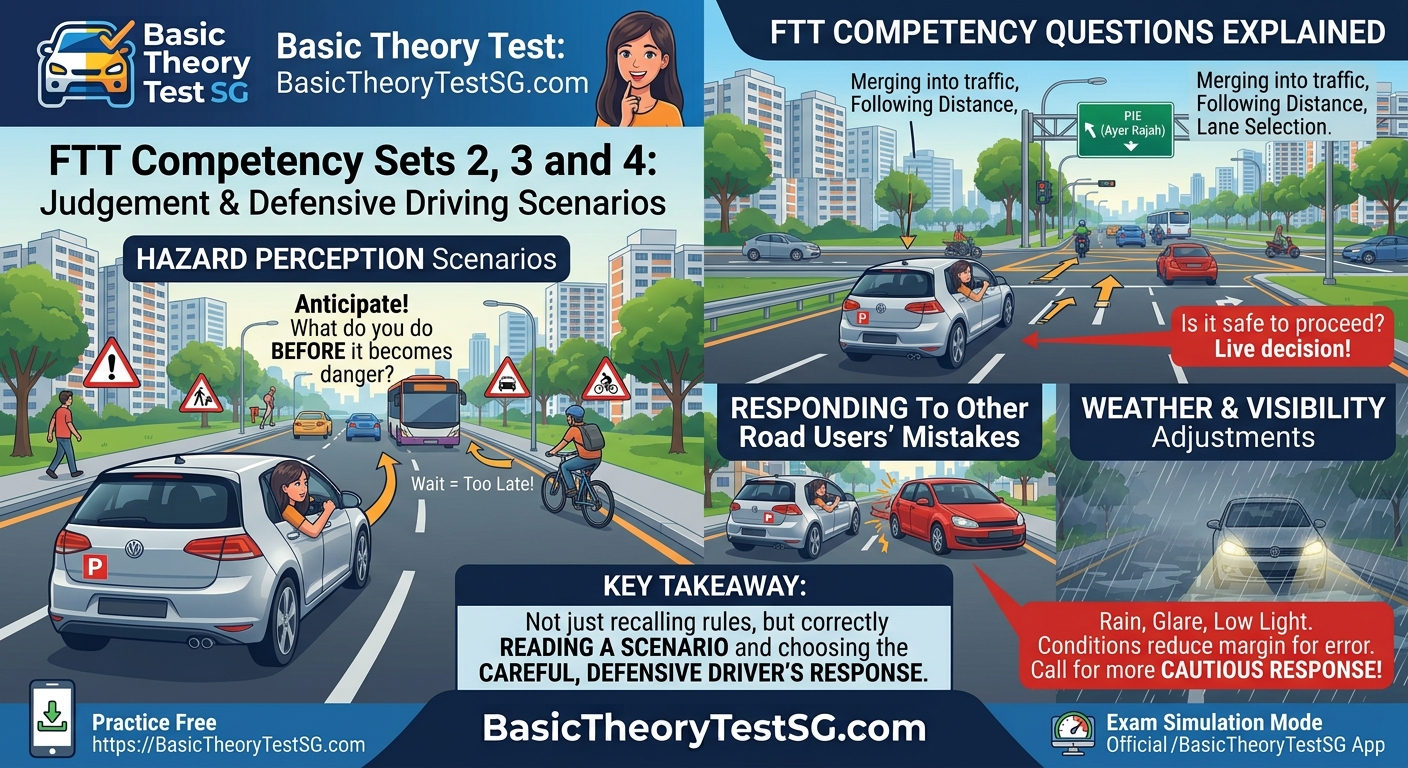
FTT Competency Questions Explained: What Sets 2, 3 and 4 Actually Test
If you have already worked through our guide to Competency 1 (clutch and centrifugal force), Sets 2, 3 and 4 can feel like a different kind of challenge entirely. There is no single mechanical concept holding each set together the way clutch control does for Competency 1. Instead, these sets test something harder to pin down: sound judgement under realistic, sometimes ambiguous driving conditions.
Why These Sets Feel Harder to Study For
Most BTT and even some FTT categories reward learning a specific rule or number. Competency Sets 2 through 4 reward a different skill: correctly reading a described scenario and picking the response a careful, defensive driver would actually choose, even when more than one answer sounds reasonable at first glance. This is deliberate. The FTT exists precisely to test whether you can apply road rules under realistic pressure, not just recall them.
Hazard Perception Scenarios
A recurring question style describes a developing situation, a pedestrian near the kerb, a car braking ahead, a cyclist drifting toward your lane, and asks what you should do before the hazard fully materialises. The skill being tested is anticipation, not reaction. Questions here are written so that waiting until the hazard is obvious is treated as too late, even if a response at that point could technically still avoid a collision.
Need Help or Have Test Tips to Share?
Our official forum is now open! Ask questions about tricky BTT/FTT rules, share your driving test experiences, or help fellow learners pass on their first try.
Judging Safe Gaps and Positioning
Several questions describe a gap in traffic, a merging vehicle, or a following distance, and ask you to judge whether it is safe to proceed. This overlaps with material from the following distance and lane discipline categories, but competency questions tend to frame it as a live decision within a scenario rather than a standalone rule, which is why revising those categories first genuinely helps here.
Responding to Other Road Users' Mistakes
A distinctive feature of these sets is scenarios where another driver, cyclist, or pedestrian does something wrong or unpredictable, and the question asks how you should respond. The consistent principle tested: you are not being asked to judge who was at fault, you are being asked what the safest response is given the situation as it now stands. A question describing another driver cutting into your lane without signalling is not really asking whether that driver was wrong. It is asking what you do next.
Weather and Visibility Adjustments
Some competency questions place a standard scenario in reduced visibility, heavy rain, glare, or low light, and ask whether your response should change. This connects directly to material covered in our headlights and flood driving guide, and the same underlying principle applies: conditions that reduce your margin for error call for a more cautious response, not the same response executed faster.
Why "Common Sense" Alone Is Not Enough
Learners often assume competency questions are simply testing common sense, and while that is partly true, the trap is that common sense without the specific defensive driving framework the FTT is built around can lead you to a reasonable sounding wrong answer. A response that avoids immediate danger is not automatically the same as the response a defensive driver, actively managing risk before it becomes danger, would choose.
How to Actually Prepare for These Sets
- Treat every scenario question as two questions in one: what is actually happening, and separately, what would a cautious driver do about it, since misreading the first half is a common source of wrong answers.
- Revisit related BTT categories (following distance, lane discipline, right of way) before drilling competency sets, since scenario questions often assume that base knowledge is already solid.
- When you get a question wrong, check whether you misjudged the scenario or misjudged the correct response. These are different gaps and need different fixes.
- Do not rush these sets the way you might rush a straightforward recall question. The extra few seconds spent reading the full scenario carefully is rarely time wasted here.
Read Our Latest Guide
Judgement calls like these also apply to specific posted speed zones. Our latest guide, School Zones and Silver Zones: Singapore Speed Rules Explained, breaks down exactly what changed under the 2026 rules.
Practise These Sets Free
You can run FTT Competency Sets 2, 3 and 4 as many times as you need, with instant review of every question you get wrong so you know exactly what to revisit. If you would rather study on the go, the same question bank is available in our official app on Android and iOS.
Once these sets feel solid, put your judgement to the test under real exam pressure with our Exam Simulation Mode, a timed fifty question mock exam that mirrors the actual BTT and FTT format.