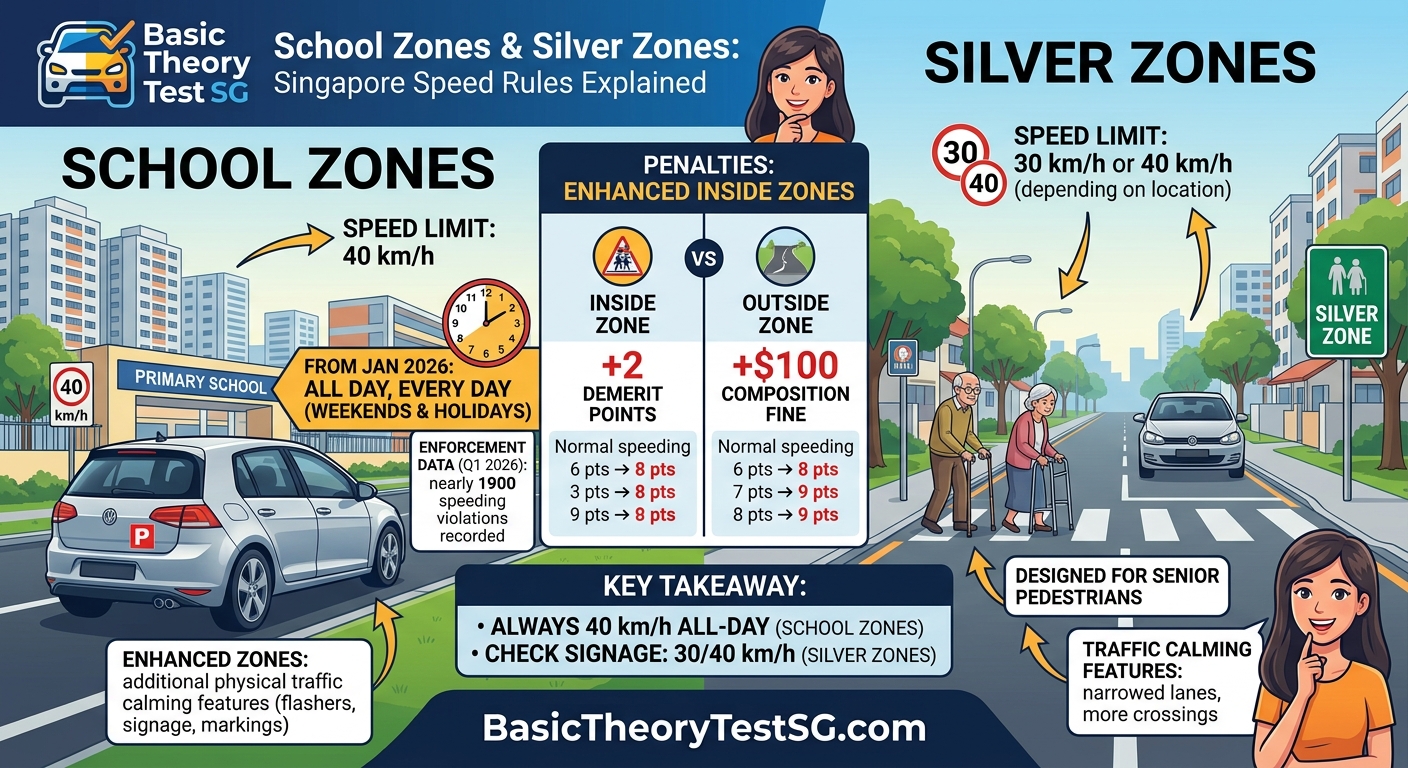
School Zones and Silver Zones: Singapore Speed Rules Explained
School Zones and Silver Zones are two of the most heavily tested topics in the BTT speed limit questions, and the rules around them changed meaningfully at the start of 2026. Here is what every learner and licensed driver needs to know.
What Is a School Zone?
A School Zone is a stretch of road near a primary school or special education school where a lower speed limit applies, supported by signage, road markings, and in many locations flashing beacons to catch a driver's attention.
Some School Zones are classified as Enhanced School Zones, which include additional physical features designed to make drivers slow down and pay closer attention. According to LTA, these extra features are what distinguish an Enhanced School Zone from a regular one, though the underlying speed limit rule is the same for both.
Need Help or Have Test Tips to Share?
Our official forum is now open! Ask questions about tricky BTT/FTT rules, share your driving test experiences, or help fellow learners pass on their first try.
The Big 2026 Change
Before 1 January 2026, the 40 km/h School Zone limit was generally enforced during specific periods, mainly around school arrival and dismissal times. From 1 January 2026, that changed. The lower speed limit now applies throughout the entire day, every day, including weekends and school holidays, regardless of whether students are actually present.
Enforcement data backs this up clearly. In the first quarter of 2026 alone, police recorded nearly 1,900 speeding violations in School Zones, suggesting many drivers were still adjusting to the fact that the old "only during school hours" assumption no longer holds.
What Is a Silver Zone?
Silver Zones are areas with enhanced road safety features designed to protect senior pedestrians, typically found in housing estates with a higher population of elderly residents. Depending on the location, the speed limit in a Silver Zone is either 40 km/h or 30 km/h, so it is important to check the posted sign rather than assume a single fixed number.
Like School Zones, Silver Zones often include traffic calming features such as narrowed lanes and additional pedestrian crossing points to physically encourage slower driving, not just signage alone.
Penalties Inside a School Zone or Silver Zone
Since 1 July 2021, specified traffic offences committed inside a School Zone or Silver Zone carry enhanced penalties on top of the normal punishment for that offence:
- An additional 2 demerit points
- An additional $100 composition fine
To put that in context, a speeding offence that would normally attract 6 demerit points outside these zones becomes an 8 point offence inside one. The same uplift applies to other specified offences too, such as illegal mobile phone use while driving.
These enhanced penalties apply on top of Singapore's broader 2026 speeding penalty revisions, which already increased composition fines and raised demerit point bands for higher speed violations across the board. Combine a general speeding offence with a School Zone or Silver Zone location, and the total penalty can climb quickly.
Why the BTT Tests This So Often
School Zones and Silver Zones sit at the intersection of two things the exam cares about deeply: correct speed limit recall, and understanding that penalties are not uniform everywhere on the road. A question might ask for the speed limit itself, whether the 40 km/h rule applies at a specific time of day, or how many extra demerit points apply for an offence inside one of these zones. Getting the "all day, every day" detail wrong is one of the most common mistakes since the January 2026 rule change.
Key Takeaway
Treat every School Zone as 40 km/h at all times, not just during school hours, and check Silver Zone signage carefully since the limit can be either 40 km/h or 30 km/h. Any offence inside either zone costs you more than the same offence elsewhere on the road, so these are two of the easiest places to lose demerit points if you are not paying attention.
Speed limit questions like these often overlap with another area the FTT expects you to reason through carefully. If you have not seen it yet, our latest guide on the FTT and how it differs from the BTT breaks down exactly what to expect once you move on to that stage.