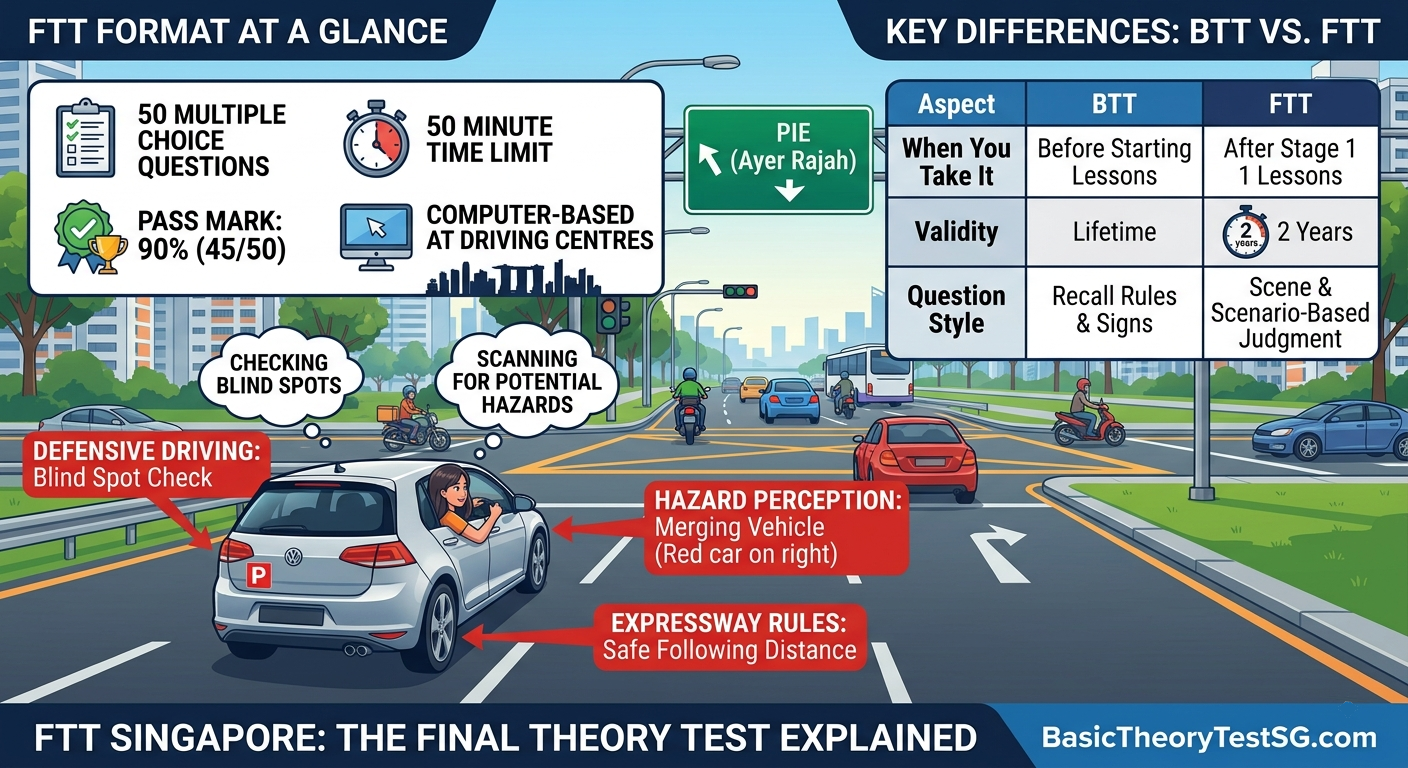
FTT Singapore: The Final Theory Test Explained
If you have already passed your BTT, the FTT is the next milestone standing between you and your practical driving test. It looks similar to the BTT on the surface, 50 questions, 50 minutes, but the content and the way questions are asked are noticeably different. Here is what the FTT actually covers, how it differs from the BTT, and how to prepare for it properly.
What Is the FTT?
The Final Theory Test, commonly shortened to FTT, is the second of two compulsory theory exams every learner driver in Singapore must pass. Where the BTT tests foundational knowledge such as road signs and basic traffic rules, the FTT builds on that foundation and tests your judgement in real world driving situations.
You are only eligible to sit the FTT after you have passed the BTT and completed the required Stage 1 practical lessons at your driving centre. This means the FTT is not something you can attempt on day one; it comes after you already have some hands on driving experience to draw from.
Need Help or Have Test Tips to Share?
Our official forum is now open! Ask questions about tricky BTT/FTT rules, share your driving test experiences, or help fellow learners pass on their first try.
FTT Format at a Glance
- Number of questions: 50 multiple choice questions
- Time limit: 50 minutes
- Pass mark: 90%, meaning at least 45 correct answers
- Test venue: Computer based, at one of Singapore's approved driving centres
The format mirrors the BTT closely, so the exam experience itself will feel familiar. What changes is the depth of thinking each question demands.
What Topics Does the FTT Cover?
Where the BTT leans heavily on recognising signs and recalling straightforward rules, the FTT shifts toward scenario based questions that test how well you apply those rules under realistic conditions. Common FTT topics include:
- Defensive driving and hazard perception
- Expressway driving, including merging, exiting, and safe following distances at higher speeds
- Vehicle handling and basic maintenance awareness
- Complex, multi factor traffic scenarios rather than single rule recall
- Road courtesy and shared responsibility with other road users
Many candidates who found the BTT straightforward are caught off guard by the FTT, precisely because the questions require you to weigh several factors at once rather than recall a single fact.
How the FTT Differs From the BTT
| Aspect | BTT | FTT |
|---|---|---|
| Question style | Straightforward rules and sign recognition | Scenario based, often multi factor |
| When you take it | Before starting practical lessons | After Stage 1 practical lessons |
| Validity once passed | Lifetime | 2 years |
That validity difference matters. Your BTT pass never expires, so there is no urgency there. Your FTT pass, however, starts a 2 year clock, and you must finish your remaining practical lessons and pass the practical driving test within that window.
How to Prepare for the FTT
Since FTT questions test understanding rather than pure recall, memorising answers from a question bank is not enough on its own. A few habits make a real difference:
- Read the official Final Theory of Driving handbook fully at least once before relying on practice questions
- After every practice test, review each wrong answer and understand the reasoning, not just the correct option
- Pay close attention to wording, since FTT questions are often phrased differently from what you may expect based on BTT style questions
- Use your practical lesson experience actively. Concepts like blind spots, following distance, and hazard perception make more sense once you have felt them behind the wheel
Key Takeaway
The FTT is where theory starts to meet real judgement. It is not simply a harder version of the BTT; it is testing a different skill, your ability to reason through a driving situation rather than recall a fact. Give yourself time with the official handbook, take the scenario based questions seriously, and use what you are learning in your practical lessons to reinforce your FTT preparation.
Distraction behind the wheel is one of the scenarios the FTT expects you to reason through carefully. If you have not yet seen it, our latest article on mobile phone rules while driving in Singapore covers exactly the kind of judgement call the FTT likes to test.