Mobile Phones and Driving in Singapore: Current Rules and a Major 2026 Change
Our Rules and Regulations category covers a wide mix of legal requirements, and few of them are changing as fast as this one right now. Mobile phone use behind the wheel is already tightly regulated in Singapore, and a Bill passed in Parliament in August 2026 will tighten it even further once it takes effect. Here is exactly where the law stands today, and what is coming.
The Current Law: Section 65B of the Road Traffic Act
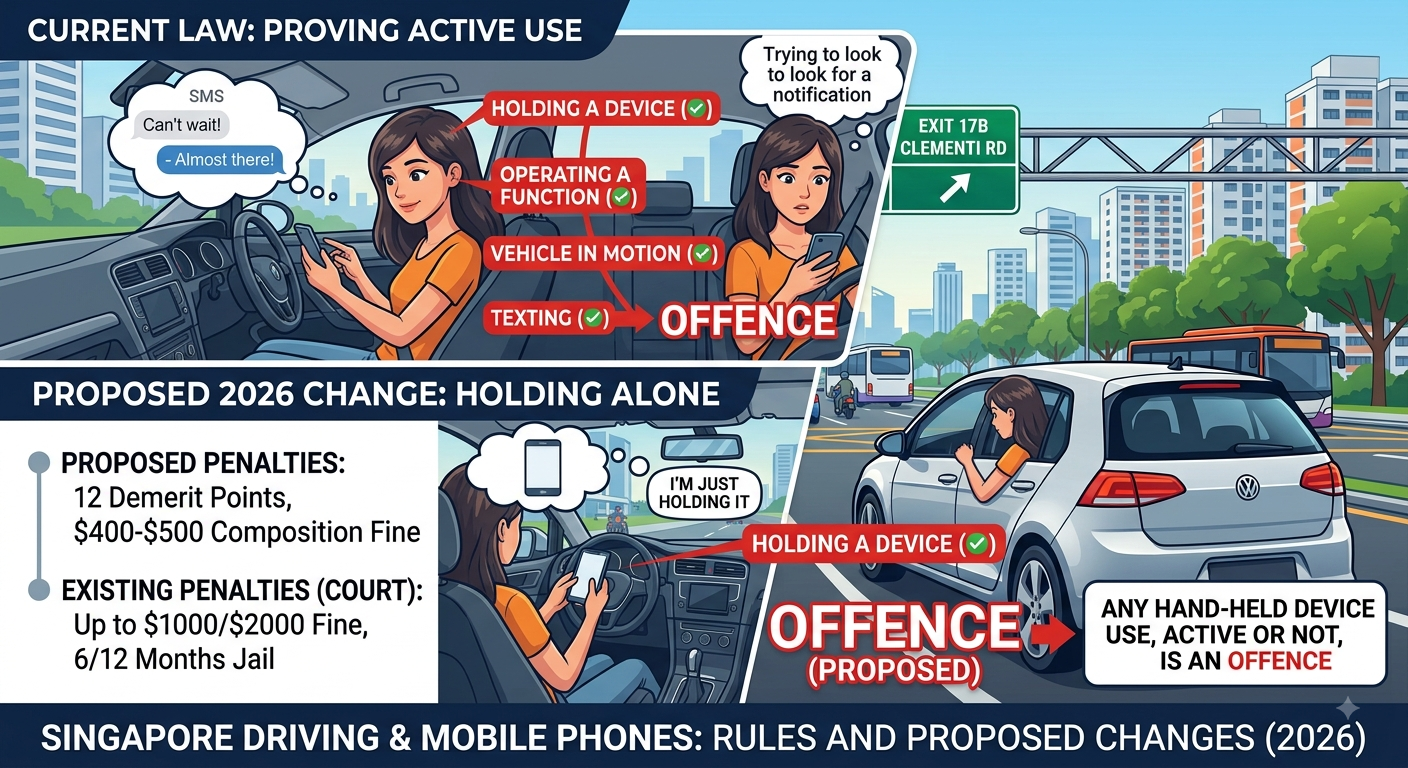
Right now, an offence under Section 65B requires three things to all be true at once:
- You are holding a mobile communication device in your hand.
- You are operating one of its functions, such as calling, texting, scrolling, or checking a notification.
- Your vehicle is in motion.
If all three apply, you can face a fine of up to $1,000, up to 6 months in jail, or both, for a first offence. Repeat offenders face steeper penalties: a fine of up to $2,000, up to 12 months in jail, or both, along with demerit points and a real risk of disqualification. These are the rules currently in force, and the ones you will still be tested on for the BTT or FTT until the new law commences.
Need Help or Have Test Tips to Share?
Our official forum is now open! Ask questions about tricky BTT/FTT rules, share your driving test experiences, or help fellow learners pass on their first try.
What Is Still Allowed
The law has never banned phones from a moving vehicle entirely. Using a phone that is properly mounted on a dashboard or windscreen holder, for hands free navigation, remains permitted. The issue has always been holding the device while actively using its functions, not the presence of a phone in the car.
The Change: Holding Alone Is Now Enough — Once the Law Takes Effect
On 7 July 2026, the Ministry of Home Affairs introduced the Road Traffic (Miscellaneous Amendments) Bill in Parliament for its First Reading. It had its Second Reading on 4 August 2026, and Parliament has since passed the Bill. One of its central changes targets exactly the weak point in the old law: proving active use.
Previously, Traffic Police officers needed to observe and establish that a driver was genuinely doing something on the phone, texting, calling, or browsing, not just holding it. This made enforcement harder in practice, since a driver could often claim they were about to put the phone down, or were not actually using any function.
Under the passed amendment, that requirement is removed entirely. Simply holding a mobile communication device in your hand while the vehicle is moving will be enough to constitute an offence, regardless of whether you were calling, texting, checking a notification, or doing nothing at all with it. The government's stated reasoning is straightforward: holding a phone reduces the likelihood that a driver is fully focused on the road, so removing the need to prove active use makes the law both safer and easier to enforce.
What the Penalties Look Like
This new, simpler "holding" offence carries 12 demerit points, with a composition fine of $400 for light vehicles and $500 for heavy vehicles. This sits alongside the existing, more serious penalties for active use, which remain a matter for court prosecution with fines up to $1,000 or $2,000 and possible jail time, depending on whether it is a first or repeat offence.
What Stays the Same
Even under the new law, phones mounted on a proper holder for hands free navigation remain permitted. The target of this amendment is handling the device, not having one in the vehicle at all.
Where Things Stand Right Now
As of this update, the Bill has been passed by Parliament but is not yet in force. The changes only come into legal effect once the Government announces an official commencement date — this is standard practice for Singapore legislation, giving agencies and drivers time to prepare. Until that date is announced, the current Section 65B rules (all three conditions required) remain the ones enforced, and the ones you will be tested on for the BTT or FTT.
That said, drivers should treat the new rule as effectively already in place. Once commencement is announced, there is typically little lead time, and Traffic Police have signalled plans to lean more heavily on cameras with video analytics to detect phone use automatically.
The Safest Habit, Regardless of Which Version of the Law Applies
Whichever stage this Bill is at when you are reading this, the practical takeaway is the same: treat your phone as something you do not touch at all once your vehicle is moving. Mount it before you set off if you need navigation, and leave it there. A habit built around the strictest possible version of the rule never puts you at risk, no matter which version of the law is in force when you are actually on the road.
Read the Latest From Our Blog
If a siren catches you off guard while you are driving, knowing the right response matters just as much as knowing the rules of the road. Our latest guide, Emergency Vehicles: How to Respond When You Hear a Siren, walks through exactly what to do.
Practise This Category Free
You can run the Rules and Regulations category as many times as you need, with instant review of every question you get wrong so you know exactly what to revisit. If you would rather study on the go, the same question bank is available in our official app on Android and iOS.