Singapore's New Traffic Cameras: What They Catch and Why It Matters
A lot of BTT and FTT prep focuses on knowing the rule. What's changed recently in Singapore is how consistently that rule actually gets enforced, and it's worth understanding if you're driving here regularly rather than just sitting an exam once and moving on.
What the New Cameras Actually Catch
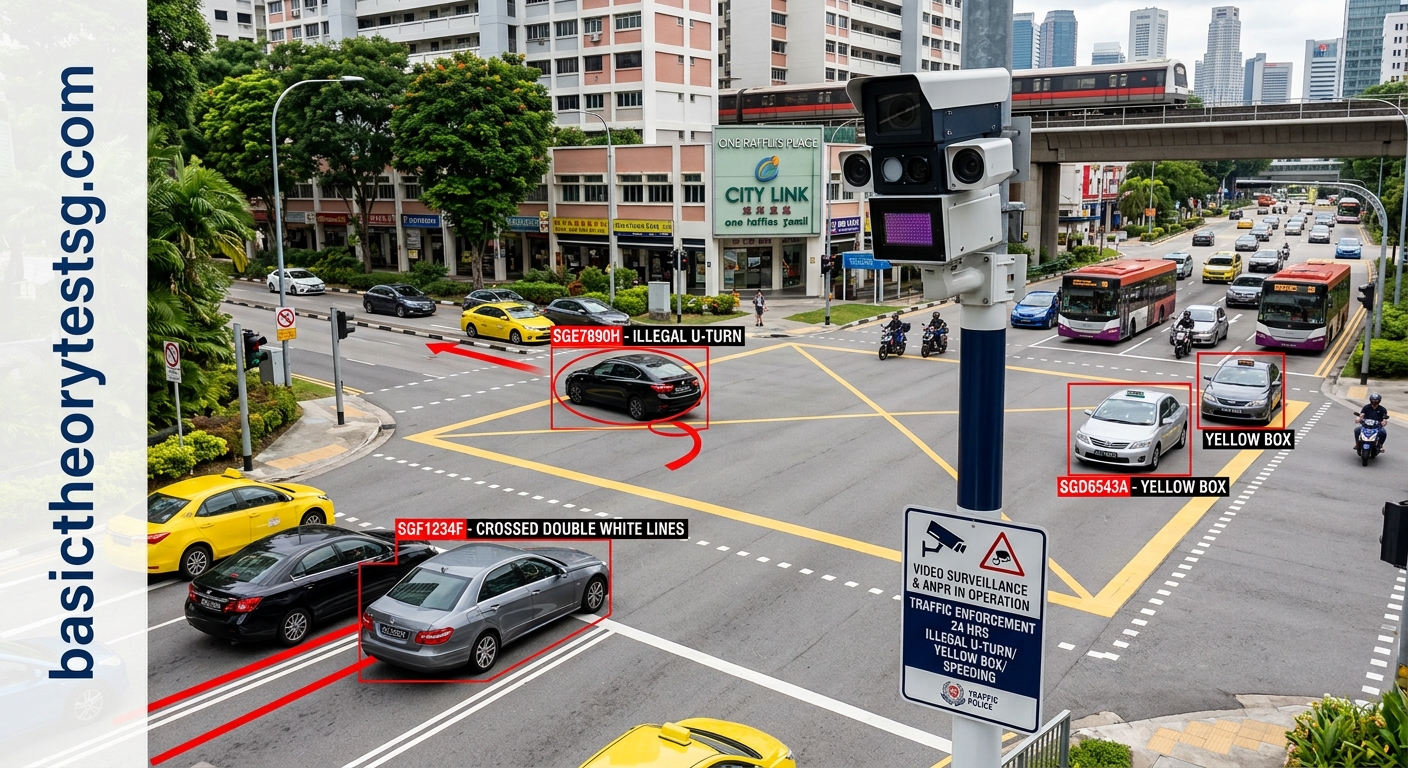
The new Traffic Violation Enforcement Cameras, or TVECs, are built to detect offences that traditional red light and speed cameras were never designed to catch. Using video analytics combined with automatic number plate recognition, they can identify illegal U-turns, vehicles crossing double white lines, drivers ignoring directional signs, and cars stopping inside yellow box junctions, all in real time. Once an offence is detected, the system automatically logs video evidence along with the vehicle's plate number, time, and the nature of the violation, which officers can then review before taking enforcement action.
If any of those offence types sound familiar, they should. Our own U Turns, Reverse Parking and Reversing Rules guide covers exactly this category, including where U-turns are legally allowed and why double white lines rule them out entirely. What's changed isn't the rule itself, it's that getting away with bending it has become significantly less likely.
Need Help or Have Test Tips to Share?
Our official forum is now open! Ask questions about tricky BTT/FTT rules, share your driving test experiences, or help fellow learners pass on their first try.
Why This Rollout Happened
The push toward camera based enforcement follows a genuinely difficult year on Singapore's roads. Road fatalities reached 149 deaths in a recent 12 month period, the highest figure recorded in a decade, and Traffic Police have pointed to this rise as the direct motivation behind expanding automated coverage. Manual enforcement by auxiliary officers simply can't provide round the clock coverage at every accident prone junction, which is exactly the gap these cameras are designed to close.
An initial trial phase recorded thousands of violations across multiple locations before the system became fully operational, with no penalties issued during that testing window while accuracy was being calibrated. That grace period is now over in areas where the cameras are active.
Updated Speeding Fine Tiers
Alongside the new cameras, composition fines for speeding were revised, with light vehicle penalties now structured in clearer bands based on how far over the limit a driver was caught: a lower fixed fine for exceeding the limit by up to 20 km/h, a higher tier for 20 to 30 km/h over, and a further increase for 30 to 40 km/h over, with anything beyond that generally prosecuted in court rather than settled with a fine. Heavier vehicles face steeper amounts across the same bands. If you're already familiar with how demerit points work, it's worth revisiting our demerit points guide, since fine amount and demerit points are separate consequences that both apply to the same offence.
Mobile Cameras Are Part of the Mix Too
Beyond fixed installations, mobile speed cameras have started appearing at specific expressway stretches where speeding has historically been a concern, giving Traffic Police the flexibility to shift enforcement to wherever the data shows it's needed most, rather than relying only on cameras in fixed, well known locations. This mirrors a pattern seen in other countries moving toward less predictable, more adaptive enforcement.
An AI System Is Also Coming
Traffic Police have also begun trialling an AI powered system designed to review traffic violation videos submitted by members of the public, aiming to cut case processing times significantly. Officers remain in the loop throughout, with the system positioned as a way to speed up review rather than replace human judgement in deciding whether an offence occurred. For everyday drivers, the practical effect is the same either way, footage submitted by another road user is now more likely to actually result in enforcement action within a reasonable timeframe.
What This Actually Means for You
- Offences that used to rely on an officer physically witnessing them, like an illegal U-turn or a yellow box stop, are now far more likely to be caught automatically.
- Coverage is shifting toward round the clock monitoring rather than manual patrols with limited hours.
- Speeding fines are now tiered more precisely based on exactly how far over the limit you were, so a small margin can matter more than it used to.
- Video submitted by other drivers or pedestrians is being processed faster, so dashcam footage of your driving is more likely to lead somewhere than it once was.
None of this changes what the rules actually are, the BTT and FTT still test the same principles they always have. What's changed is the gap between knowing a rule and actually being held to it, and that gap has gotten a lot smaller.