U Turns, Reverse Parking and Reversing Rules: Singapore BTT Guide
Our U Turn and Reversing category is one of the smaller sets in the BTT question bank, but it punches above its weight when it comes to real world driving mistakes. Reversing and U turns are two of the few manoeuvres where you're deliberately moving against the normal flow of traffic, which is exactly why the rules around them are so specific.
Here's what tends to trip learners up, both on the exam and later on the road.
Where U Turns Are Actually Allowed
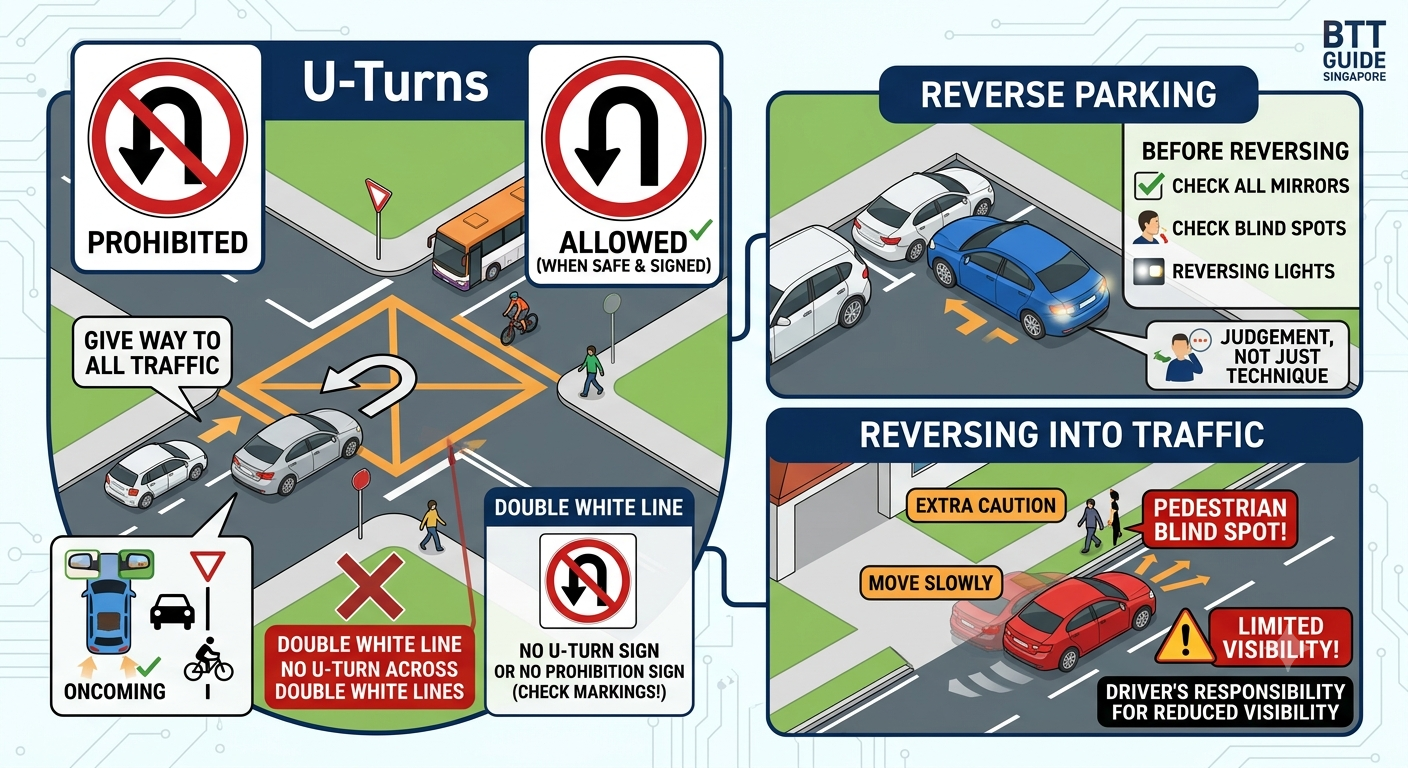
A U turn is only permitted where a sign specifically allows it, or where no sign prohibits it and the manoeuvre can be completed safely without obstructing other road users. Many learners assume the absence of a "No U Turn" sign automatically means it's fine, but the real test is whether the turn can be made without forcing other vehicles to slow, stop, or swerve. On roads with a single unbroken white line or a double white line, U turns are not allowed at all, regardless of signage.
Need Help or Have Test Tips to Share?
Our official forum is now open! Ask questions about tricky BTT/FTT rules, share your driving test experiences, or help fellow learners pass on their first try.
This is a common trap in BTT scenario questions: a junction is shown with no explicit prohibition sign, but the road markings themselves rule out the manoeuvre. Reading the markings, not just the signs, is the key skill being tested.
The Rule Every Learner Forgets: Give Way to Everyone
When performing a U turn, you must give way to all other traffic, including oncoming vehicles, cyclists, and pedestrians who are already using the road or crossing. A U turn is treated as the more disruptive manoeuvre in almost every priority scenario, so the default assumption in an exam question should be that everyone else has the right of way over you, not the other way around.
Reverse Parking: What the Test Actually Checks
Reverse parking questions in the BTT usually focus less on the physical technique, which is tested during the practical circuit assessment, and more on judgement: when reversing is required by law, and what checks must happen before starting. Before reversing, a driver must check mirrors and blind spots, and should get out and look if visibility is genuinely obstructed rather than guessing. Reversing lights and, where fitted, a reversing alarm exist specifically because a reversing vehicle is one of the least visible hazards to pedestrians nearby.
Reversing Into Traffic: A Higher Standard of Care
Reversing out of a driveway or parking space onto a road carries a stricter responsibility than reversing within a car park. Since the driver's visibility is naturally reduced while facing backward, the law expects extra caution, including moving slowly enough to stop immediately if a pedestrian or vehicle appears. This is one of the few situations where "I didn't see them" is treated as a failure of process rather than bad luck, since the expected process already accounts for reduced visibility.
Common Mistakes That Cost Marks
- Assuming a U turn is legal simply because there's no explicit prohibition sign, without checking the road markings.
- Treating reverse parking checks as optional once mirrors have been adjusted at the start of the journey.
- Underestimating how much priority pedestrians and other vehicles have during a U turn, since it's easy to mentally treat your own turn as the "main" manoeuvre.
- Forgetting that double white lines rule out U turns entirely, even on wide roads where the manoeuvre would otherwise be physically easy.
Why This Category Matters Beyond the Exam
U turns and reversing account for a disproportionate number of low speed accidents precisely because drivers underestimate them. A reversing vehicle moving at walking pace still causes real injuries, and a mistimed U turn can force multiple vehicles into sudden braking. Treating this category as a minor footnote in BTT prep is a common mistake, since these are exactly the situations where hazard judgement matters more than raw driving skill.
If you're curious how manoeuvre rules like these compare internationally, our earlier piece on how driving theory tests differ around the world covers how other countries structure and weight similar judgement based questions.
Getting comfortable with U turns and reversing isn't just about passing this section of the BTT. These are manoeuvres you'll perform regularly once licensed, often in tight spaces with limited visibility, which makes solid judgement here one of the more practical payoffs of theory prep.