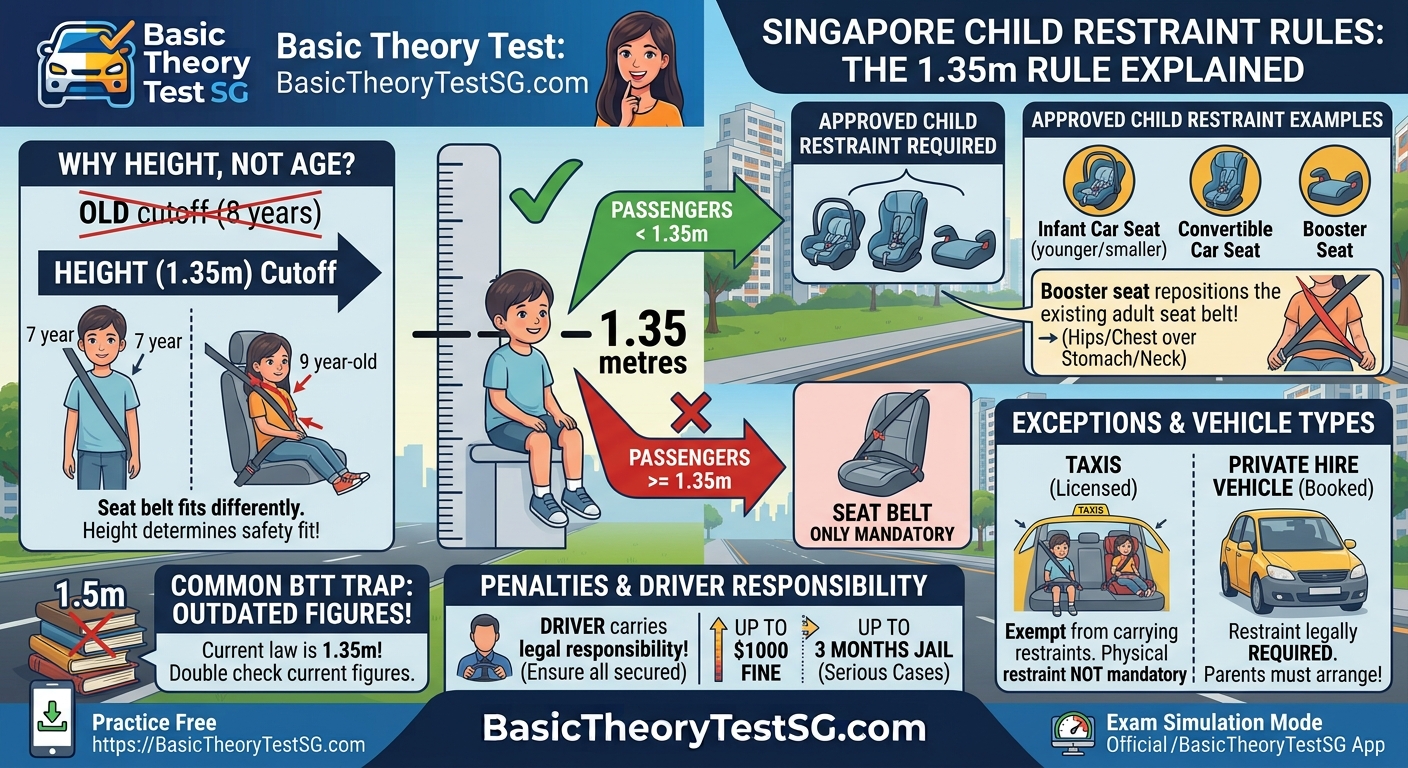
Child Car Seat and Seat Belt Exemption Rules in Singapore: The 1.35m Rule Explained
This single number, 1.35 metres, comes up constantly in both the BTT question bank and real driving decisions, yet it's one of the most commonly misremembered figures among learners. Some question banks still float older figures like 1.5 metres, which no longer reflects the current law. Here's what actually applies today. For the broader rules on who needs to buckle up and how following distance ties into safe driving, our Seat Belts and the Following Distance Rule guide covers that side of the topic in more depth.
Why Height Instead of Age
Singapore's seat belt rules used to be based on a child's age, with a cutoff around 8 years old. That approach was changed because children grow at very different rates, and a seat belt that fits a tall 7 year old properly can sit dangerously across the neck or stomach of a smaller 9 year old. Height determines whether a standard adult seat belt can physically protect a passenger the way it's designed to, so the law shifted to a height based threshold instead.
What Counts as an Approved Child Restraint
Below 1.35 metres, a passenger needs one of the following depending on their size, rather than a standard adult seat belt alone:
Need Help or Have Test Tips to Share?
Our official forum is now open! Ask questions about tricky BTT/FTT rules, share your driving test experiences, or help fellow learners pass on their first try.
- An infant or convertible car seat with its own harness, for younger or smaller children.
- A booster seat, which raises a child high enough for the existing adult seat belt to sit correctly across the hips and chest rather than the stomach and neck.
A booster seat isn't a separate restraint system on its own. It works together with the car's existing seat belt, simply repositioning where the belt sits on the child's body.
The Taxi Exception, and Why Private Hire Is Different
Licensed taxis are exempt from the requirement to carry child restraints, since a taxi can't reasonably be expected to stock a range of child seats for passengers who hail it on the street. Children under 1.35 metres travelling by taxi must still sit in the rear seat, but a physical restraint isn't mandatory in that specific case.
Private hire vehicles booked through an app are treated differently and are not exempt. If a booking involves a child under 1.35 metres, an appropriate restraint is legally required, and parents are generally expected to indicate this need when booking.
What Happens If the Rule Isn't Followed
Non-compliance can result in a fine of up to $1,000, or imprisonment of up to three months in more serious cases. The responsibility for ensuring passengers are properly secured, including any child under 1.35 metres, sits with the driver, not just the parent or guardian in the vehicle.
A Common BTT Trap
Some BTT practice questions still reference outdated height figures such as 1.5 metres or 1.6 metres as the exemption threshold. If you come across a question like this, the officially correct threshold under current law is 1.35 metres. Since question banks are occasionally slower to update than the underlying legislation, it's worth treating any seat belt height question as a cue to double check the current figure rather than assuming the answer key is automatically up to date.
Practical Takeaways
- 1.35 metres is the real threshold, not 1.5 metres or any other figure you may have seen in older material.
- Height decides the rule, not age, so a small adult can technically fall under the same requirement as a child.
- Taxis are exempt from carrying restraints, but private hire vehicles like Grab are not.
- A booster seat only works properly in combination with the vehicle's existing seat belt, it isn't a standalone system.
- The driver, not just the parent, carries legal responsibility for ensuring passengers are correctly secured.
This is one of those BTT topics that matters just as much after you pass as it does on exam day. Getting the number right isn't just about a correct answer on a practice test, it's the same figure you'll rely on every time you drive with a child in the car.