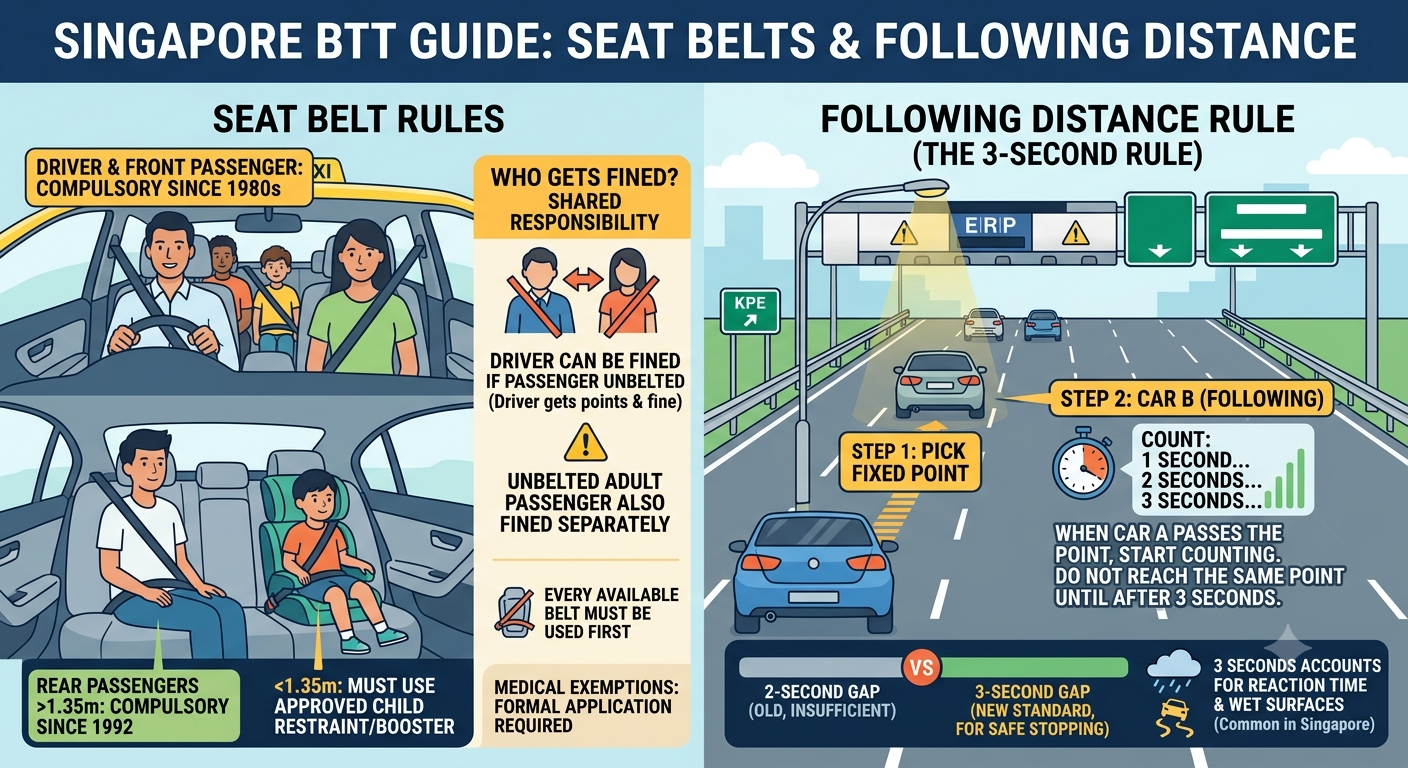
Seat Belts and the Following Distance Rule: Singapore BTT Guide
Our Seat Belt / 2 Second Rule category pairs two safety topics that do not obviously belong together at first glance, but both come down to the same idea: giving yourself and your passengers a real chance to survive a sudden impact. One quick note before we start, since it matters for this exact category: the following distance rule itself has changed. The current Traffic Police handbook now calls for a three second gap, not two. If your notes, or the category name itself, still say two seconds, that detail is outdated and worth updating in your own revision.
Seat Belt Rules: Who Must Wear One
Singapore's seat belt law is broader than many drivers assume, and BTT questions test the details rather than the general idea:
- Front seat belts have been compulsory since the early 1980s, for the driver and any front passenger.
- Rear seat belts became compulsory in 1992, for any passenger above 1.35 metres in height.
- Passengers or children below 1.35 metres must use an approved child restraint or booster seat instead of the adult belt, since a standard belt does not sit correctly on a smaller body.
- It is illegal to remove a factory fitted rear seat belt from a vehicle, even if you personally never plan to use the rear seats.
Who Actually Gets Fined
This is a frequent source of wrong answers, because the responsibility is shared in a way that catches learners off guard:
Need Help or Have Test Tips to Share?
Our official forum is now open! Ask questions about tricky BTT/FTT rules, share your driving test experiences, or help fellow learners pass on their first try.
- A driver who fails to wear a seat belt receives a fine and demerit points.
- The same driver can also be fined if a passenger in the vehicle is not properly belted up, because the law places responsibility for passenger compliance on the driver, not only on the passenger themselves.
- The unbelted adult passenger can also be fined individually, separate from any penalty the driver receives.
A BTT question describing an unbelted rear passenger is testing whether you understand that this is the driver's problem too, not just the passenger's.
When There Are More Passengers Than Seat Belts
The rule tested here is straightforward once you know it: every available seat belt in the vehicle must be used before any passenger travels unbelted. If you have more people than belts, it is the driver's call who ends up unbelted, but the vehicle still cannot legally carry more belted passengers than the number of working seat belts allows for safely.
Medical Exemptions
A small number of drivers and passengers are exempt from the seat belt requirement for genuine medical reasons. This exemption is not something a driver can simply claim on the spot. It requires a formal application, supported by a registered medical practitioner, submitted to the Deputy Commissioner of Police. Without that approval on record, "medical reasons" is not a valid excuse if stopped.
The Following Distance Rule
The second half of this category tests your understanding of a safe gap behind the vehicle in front of you. The technique itself has not changed even though the number has:
- Pick a fixed point ahead, such as a lamp post or road sign, at the moment the vehicle in front of you passes it.
- Count the seconds until your own vehicle reaches that same point.
- If you reach it in under three seconds, you are following too closely and need to increase your gap.
The extra second added in the 2026 update accounts for reaction time plus a realistic stopping distance, particularly relevant on Singapore's roads where sudden heavy rain is common and stopping distances increase sharply on a wet surface.
Why This Pairing Makes Sense
Seat belts and following distance are really the same safety principle from two different angles. A seat belt reduces the harm if a collision happens, while a safe following distance reduces the chance of a collision happening in the first place. The BTT groups them together because both come down to the same underlying habit: assuming the unexpected can happen, and preparing for it before it does.
Practise This Category Free
You can run the Seat Belt / 2 Second Rule category as many times as you need, with instant review of every question you get wrong so you know exactly what to revisit.
Once this category feels solid, put it to the test under real exam pressure with our Exam Simulation Mode, a timed fifty question mock exam that mirrors the actual BTT and FTT format.