How Driving Theory Tests Differ Around the World
If you've only ever sat the BTT, it's easy to assume every country tests new drivers roughly the same way: multiple choice questions, road signs, a pass mark, done. In practice, theory tests vary more than most people expect, both in structure and in what they actually prioritise. Understanding those differences is useful if you're relocating, converting a licence, or just curious how Singapore's approach compares.
Singapore's BTT and FTT: Two-Stage, Scenario-Heavy
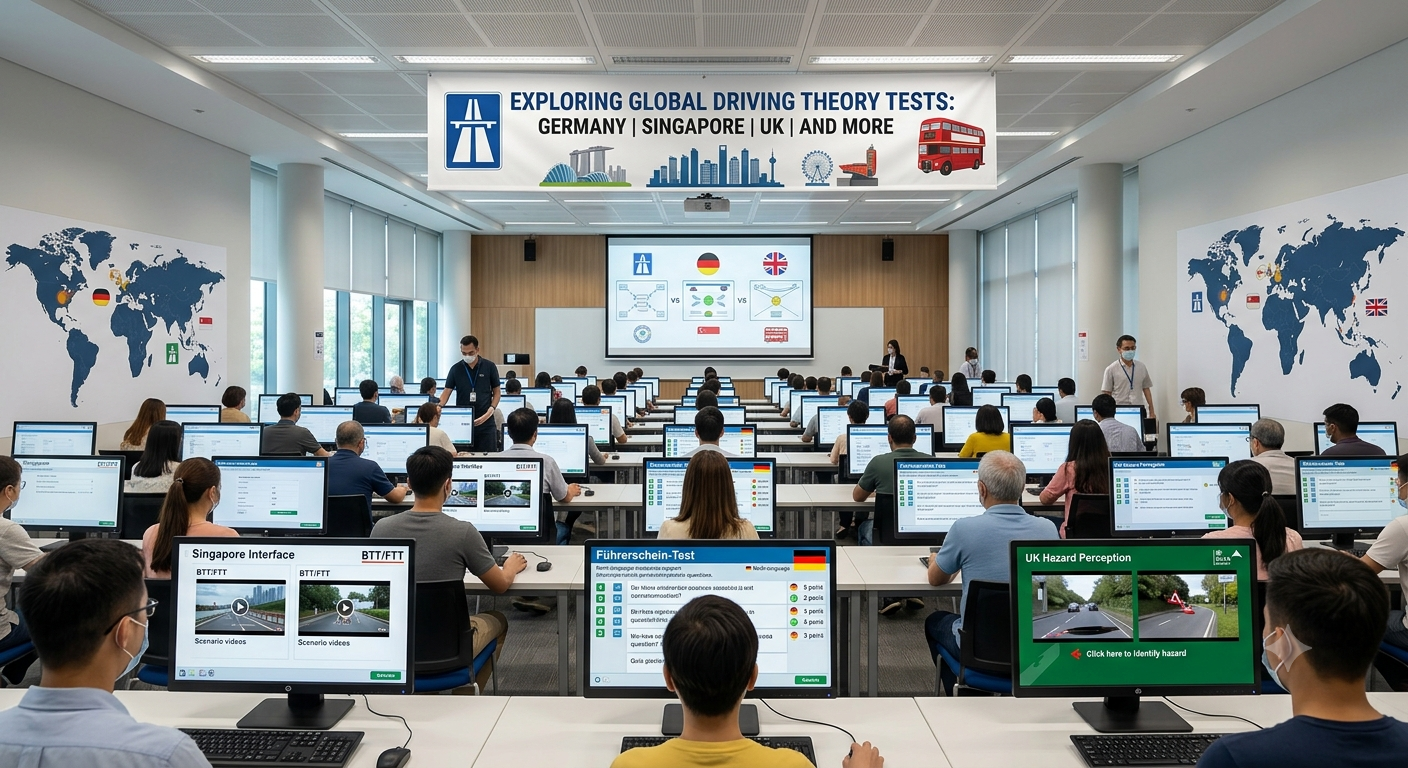
Singapore splits theory testing into two stages. The Basic Theory Test covers core road rules, signs, and general regulations, while the Final Theory Test focuses more heavily on hazard perception, risk judgement, and scenario-based questions. Both use a computer-based multiple choice format with a strict pass mark, and both draw from a large, regularly updated question bank rather than a small fixed set.
Germany's Führerschein Theory Test: Weighted Questions
Germany's approach differs in a detail that surprises a lot of first-time test takers: not all questions are worth the same number of points. Basic questions are worth fewer points, while more safety-critical questions carry more weight, meaning a candidate can answer more questions correctly overall and still fail if they get the higher-weighted ones wrong. The test also covers vehicle class-specific content depending on the licence category being pursued. For readers preparing specifically for the German exam, the Führerschein Test practice platform covers this weighted format directly, with practice questions organised the same way the real exam is structured.
Need Help or Have Test Tips to Share?
Our official forum is now open! Ask questions about tricky BTT/FTT rules, share your driving test experiences, or help fellow learners pass on their first try.
The UK's Theory Test: Two Distinct Parts
The UK combines a multiple choice section with a separate hazard perception video test, where candidates watch clips and click when they spot a developing hazard. Both parts must be passed individually, not averaged, which means strong performance on one section can't compensate for a weak one on the other.
Why the Differences Matter Beyond Trivia
These aren't just interesting quirks. If you're a Singapore resident planning to drive overseas, whether for work, study, or a longer stay, assuming your home country's test format and content will transfer directly is a common and costly mistake. A German exam won't ask about Singapore's expressway lane discipline rules, and a UK hazard perception video won't prepare you for Germany's weighted scoring system. Each system reflects local road conditions, common accident causes, and regulatory priorities, so local test prep matters even for an experienced driver.
What Stays the Same Everywhere
Despite the structural differences, a few things hold true across almost every country's theory test: right of way judgement, safe following distance, and priority for pedestrians and cyclists show up as core themes everywhere. If you've built strong habits around these fundamentals through BTT and FTT prep, that judgement transfers even when the specific rules and formats don't.
Key Takeaway
Theory tests are shaped by the roads they're built for. Singapore's scenario-heavy, two-stage format reflects dense urban traffic and a strong emphasis on hazard anticipation. Other countries weight or structure their tests differently for the same underlying reason: they're testing readiness for their own roads, not a universal standard. If you're studying for a test outside Singapore, it's worth using resources built specifically for that country's exam format rather than assuming BTT prep habits will carry over one to one.