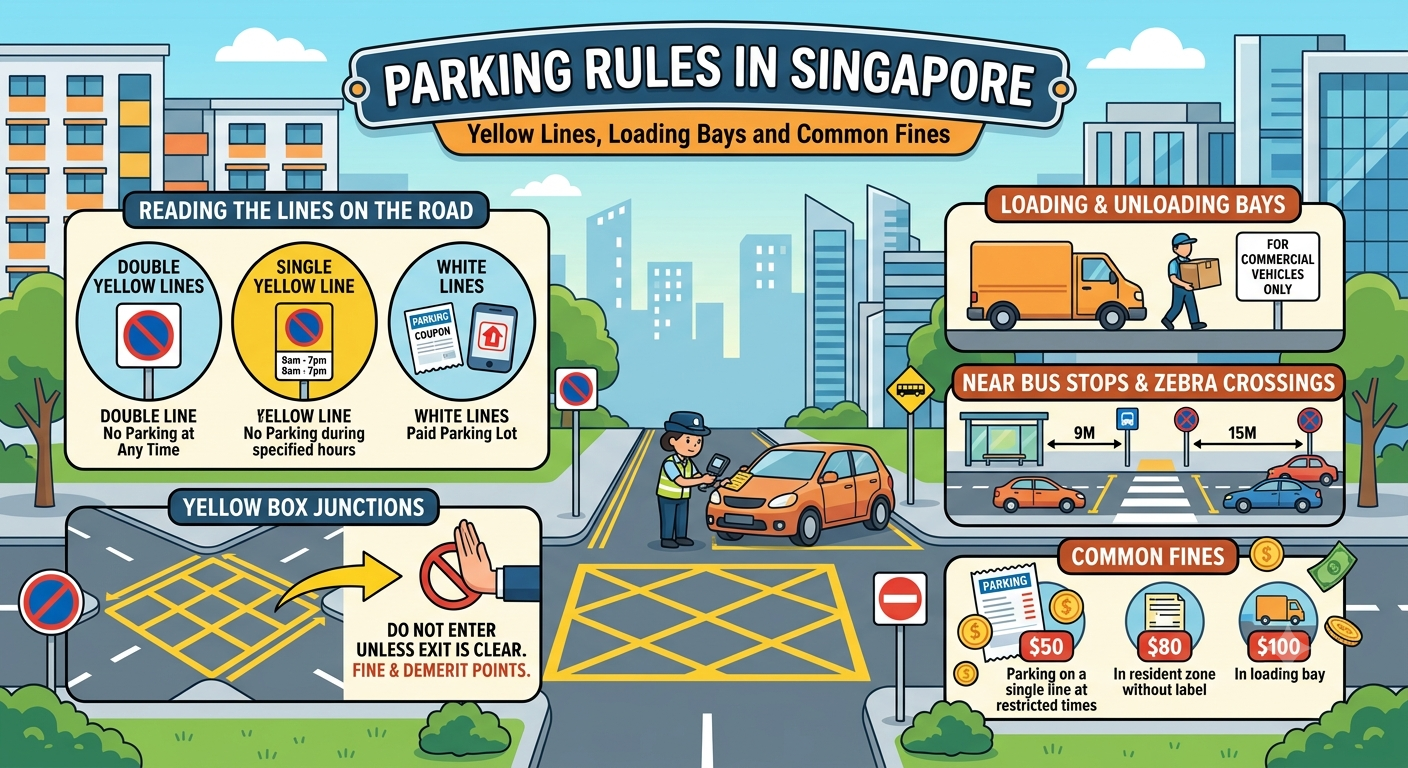
Parking Rules in Singapore: Yellow Lines, Loading Bays and Common Fines
Parking mistakes are among the easiest fines to rack up in Singapore, precisely because so many rules depend on line colour, signage, and time of day rather than anything intuitive. A spot that's perfectly legal at 10am can earn you a summons at 6pm. Knowing the system properly, rather than guessing based on where other cars happen to be parked, saves you both money and the FTT questions built around this topic.
Reading the Lines on the Road
Singapore uses colour coded road markings to indicate parking rules, and each colour carries a different meaning.
- White lines mark a standard paid parking lot, usually managed through coupons or the HDB and URA parking apps.
- Yellow lines indicate restricted parking, and the exact restriction depends on whether the line is single or double, along with any accompanying sign.
- A single yellow line usually means no parking during specified hours shown on the nearby sign, while parking outside those hours may be allowed.
- Double yellow lines mean no parking at any time, with no exceptions based on time of day.
Yellow Box Junctions
A yellow box junction is the crisscross yellow grid painted at certain intersections. Entering the box is only allowed if your exit on the other side is clear. Stopping inside the box, even briefly because traffic ahead hasn't moved, is treated as an offence and carries both a fine and demerit points. The rule exists specifically to stop gridlock from spreading across an intersection, so examiners test this concept heavily in both the BTT and the FTT.
Need Help or Have Test Tips to Share?
Our official forum is now open! Ask questions about tricky BTT/FTT rules, share your driving test experiences, or help fellow learners pass on their first try.
Loading and Unloading Bays
Loading bays, marked separately from regular parking lots, are reserved for commercial vehicles actively loading or unloading goods within a limited time window, typically shown on the accompanying sign. Parking a private car in a loading bay, even for a quick errand, is treated the same as parking in any other restricted zone.
Parking Near Bus Stops and Zebra Crossings
Certain distances around bus stops and pedestrian crossings are kept clear by law, even where no explicit yellow line is painted. Parking too close to a bus stop blocks the bus from pulling in properly, and parking too close to a zebra crossing blocks sightlines for pedestrians stepping onto the road. Both situations are common sources of fines for drivers who assume that an empty looking stretch of road is automatically fair game.
Common Situations That Lead to Fines
- Parking on a single yellow line during the restricted hours shown on the sign, often because the driver didn't check the time window carefully.
- Assuming a spot is free because no other cars are parked there, without checking for a double yellow line.
- Stopping briefly inside a yellow box junction while waiting for traffic to clear ahead.
- Parking in a resident only zone without the correct season parking label displayed.
- Leaving a vehicle unattended in a loading bay outside the permitted use case.
A Simple Habit That Prevents Most Parking Fines
Before switching off the engine, take a moment to look at the line colour, check for a nearby sign showing hours, and confirm there's no separate restriction such as a loading bay or resident zone marking. This three second check covers the vast majority of situations that otherwise lead to a parking summons.
Why This Comes Up in Your Theory Tests
Parking and stopping restrictions are a recurring category across both the BTT and FTT question banks, since examiners want to confirm you understand road markings well enough to apply them in situations you haven't specifically memorised. Rather than trying to recall individual scenarios, focus on the underlying logic behind each line colour and sign, since that same logic gets tested from multiple angles.
The Basic Theory Test SG app groups parking and road marking questions into their own dedicated category, making it easy to drill this topic specifically before moving on. Get it on Android or iOS.
If you haven't already, check out our previous article on the demerit points system, since a parking offence is one of the quickest ways to add points to your record without realising it.