Child Restraint or Seat Belt? The BTT Question That Trips Up Height, Not Age
If you've been going through our practice questions, you've probably seen this one:
A passenger is exempted from wearing a seat belt if he is below ___ in height.
It looks simple, but it's one of the questions our users get wrong most often. Here's why, and the answer, in under 15 seconds.
Why this question catches people out
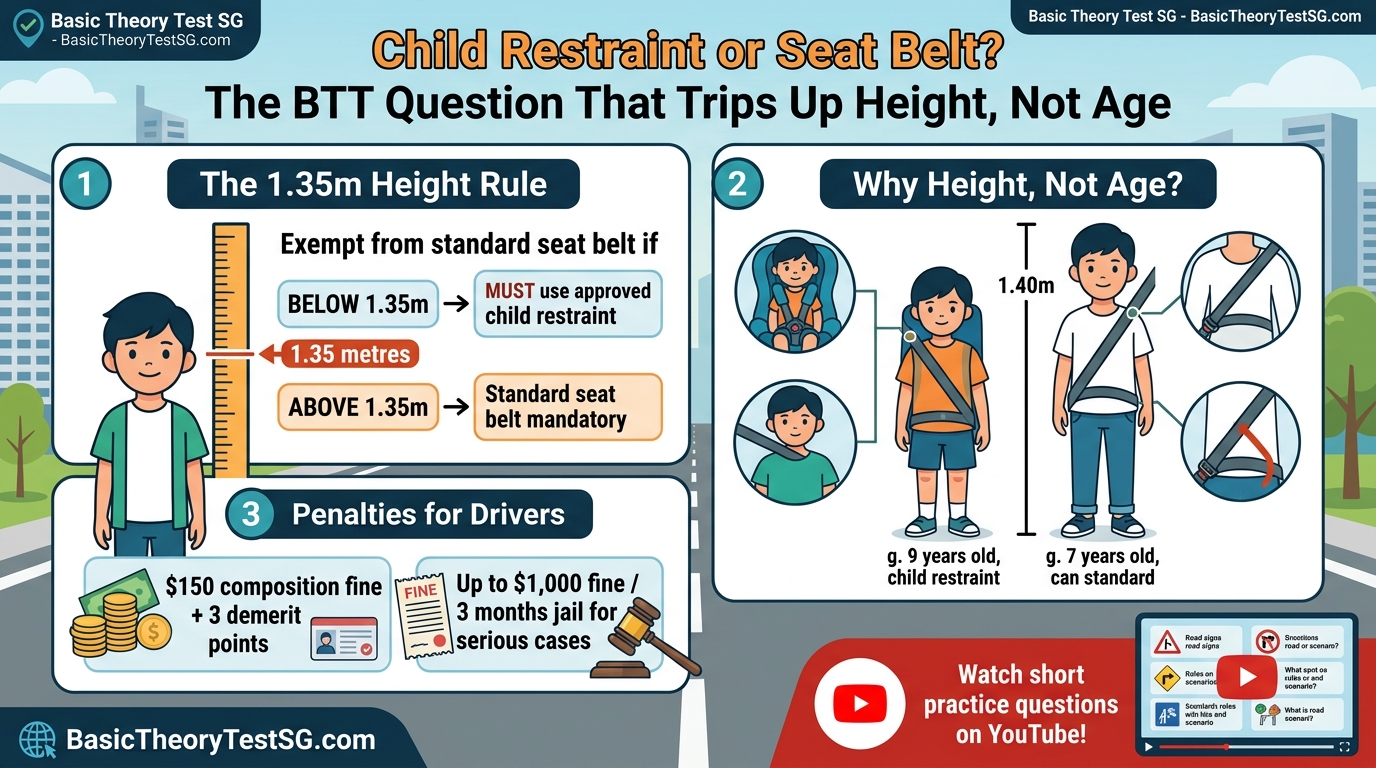
Most learners assume the seat belt exemption is about age, since that's how it works in a lot of everyday conversation ("kids don't need seat belts"). The BTT handbook doesn't test it that way. The actual rule is based on height, not age, because a booster seat or child restraint is designed around body size, not birthdays. A tall 6-year-old and a small 9-year-old don't fit the same restraint the same way, which is exactly why Singapore's rule is written around height.
Need Help or Have Test Tips to Share?
Our official forum is now open! Ask questions about tricky BTT/FTT rules, share your driving test experiences, or help fellow learners pass on their first try.
So when the exam asks you to fill in the blank, it's testing whether you know the specific figure, not just the general idea that "young kids get some kind of exemption."
The rule in plain terms
A passenger is exempt from wearing a standard seat belt if they are below 1.35m in height, and instead they must be secured using an approved child restraint appropriate for their size. Once a passenger reaches that height, the exemption no longer applies, and they're expected to wear a normal seat belt like everyone else in the vehicle.
This matters beyond the exam too. As the driver, you're the one responsible for making sure passengers under that height are properly restrained, not just "buckled in somehow." Failing to do so carries a $150 composition fine and 3 demerit points for the driver, and repeat or serious offences can be escalated to court, with penalties of up to $1,000 or 3 months' jail for a first conviction.
A pattern worth remembering
This is a good example of a broader BTT pattern: when a question gives you an exemption, check whether it's based on height, age, vehicle type, or road type, because the handbook mixes all four depending on the topic. Mixing them up is one of the most common ways to lose easy marks.
We cover more questions like this one, short, one at a time, on our YouTube channel, where each video walks through a question the same way: think it through, then see the answer revealed.
Want more rules explained the same way? Check out our latest guide: Cost of Getting a Driving Licence in Singapore in 2026: Full Breakdown.