Blind Spots and Road Safety: Singapore BTT Guide
Our Blind Spots, Road Safety and BTT General category covers one of the most practical skills tested on the entire exam, because unlike a fixed rule or a number to memorise, blind spot awareness is something you actually have to perform correctly every single time you drive. Questions here test whether you understand not just that blind spots exist, but exactly how to check them and whose blind spot you might be sitting in yourself.
What a Blind Spot Actually Is
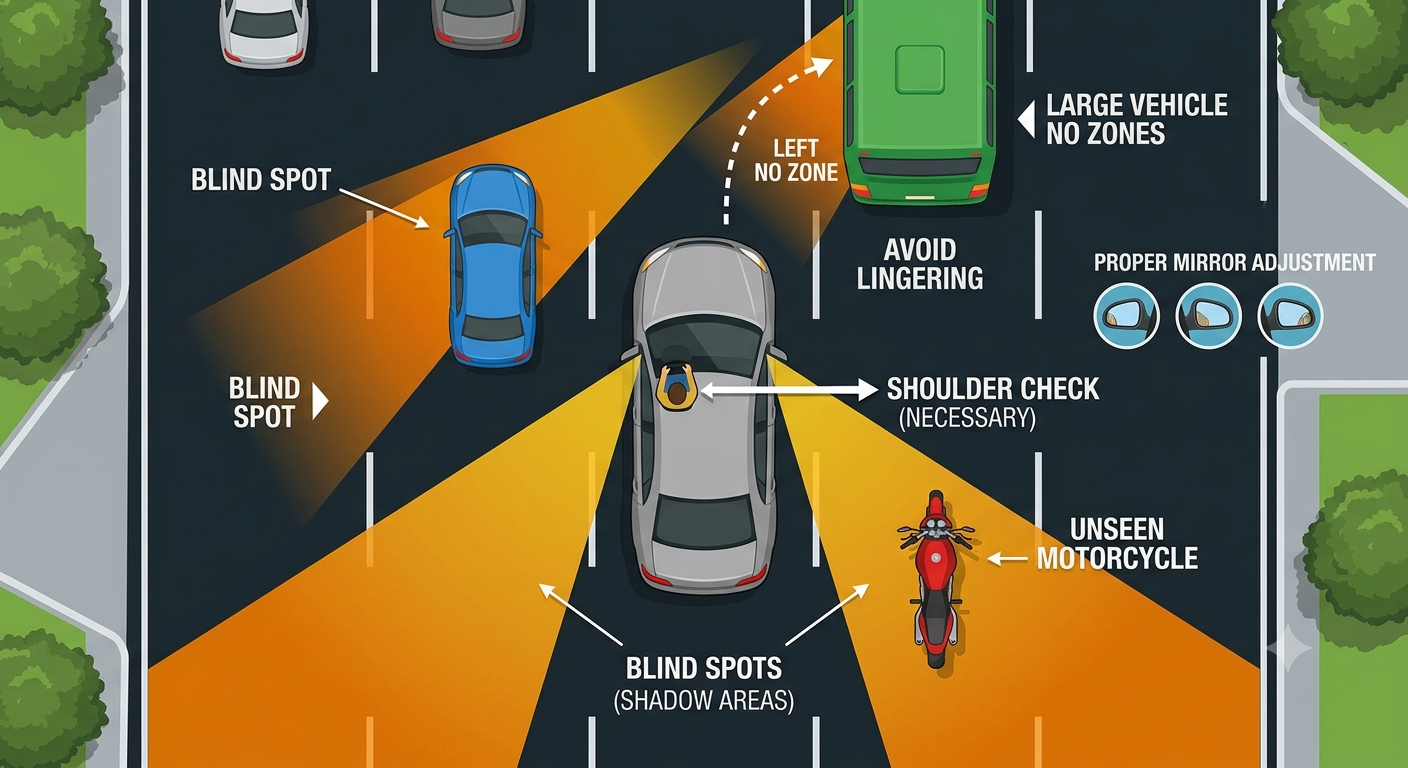
A blind spot is any area around your vehicle that is not visible through your rear view mirror or side mirrors. In a standard car, the two main blind spots sit at the rear quarter panels, roughly diagonally behind each shoulder. No matter how well your mirrors are set up, a small gap always remains that mirrors alone cannot cover.
Mirror Positioning: The First Line of Defence
Properly adjusted side mirrors can eliminate a large portion of your blind spot before you even turn your head. The common technique tested here: angle your side mirrors outward until you can just barely see the edge of your own vehicle. If you can see too much of your own car in the mirror, the mirror is angled too far inward, and you are wasting field of view on something you already know is there.
Need Help or Have Test Tips to Share?
Our official forum is now open! Ask questions about tricky BTT/FTT rules, share your driving test experiences, or help fellow learners pass on their first try.
The Shoulder Check: Why It Cannot Be Skipped
Even with perfectly positioned mirrors, a small blind spot remains that only a physical head turn can cover. This is called a shoulder check, sometimes referred to as a head check. The BTT tests this as a required step before any lane change, merge, or turn, not an optional extra for cautious drivers. A common wrong answer pattern is a scenario where a driver relies only on mirrors before changing lanes. The correct response always includes a shoulder check as well, since mirrors alone cannot confirm a blind spot is clear.
Being Aware of Other Drivers' Blind Spots
This is the half of the topic that catches out confident drivers, since it flips the usual perspective. It is not enough to check your own blind spots. You also need to avoid lingering in someone else's. A simple rule tested here: if you cannot see a driver's face in their side mirror, they almost certainly cannot see you either.
Large Vehicles and No Zones
Trucks and buses have dramatically larger blind spots than cars, due to their height and length. These are sometimes called no zones, areas around a large vehicle where a car, motorcycle, or cyclist can effectively disappear from the driver's view entirely:
- Directly in front of a large vehicle, sometimes extending several metres, since the driver sits high above the road and cannot see close to their own front bumper.
- Along both sides, particularly on the side away from the driver's seat, where the blind zone extends further than most drivers expect.
- Directly behind, often the largest no zone of all, which is why following too closely behind a bus or truck is especially risky.
A related detail worth remembering: large vehicles sometimes need to swing wide before making a turn, particularly a left turn from what looks like the wrong lane. Never cut into the gap between a turning bus or truck and the kerb, since that gap exists because of how the vehicle needs to manoeuvre, not as an invitation to pass.
Motorcycles and PMDs Have Blind Spots Too
The same principles apply to smaller road users, though the BTT tends to test this from the car driver's perspective: motorcycles and personal mobility devices are small enough that they can sit unnoticed in a blind spot far more easily than another car would. Extra care during shoulder checks matters even more when the vehicle you might miss is significantly smaller than a car.
Blind Spots at Junctions
Junctions add another layer, since parked vehicles, roadside structures, or even the angle of the road itself can hide an approaching vehicle or pedestrian regardless of your mirrors. The BTT General portion of this category often tests a broader principle here: having the right of way does not remove the need to stay alert, since another road user's view of you (or yours of them) can be blocked by something entirely outside either driver's control.
Why This Category Rewards Habit, Not Memorisation
Most BTT categories test whether you know a specific rule or number. This one tests whether you have internalised a physical habit: mirrors, signal, shoulder check, then manoeuvre, every single time, regardless of how confident you feel about the gap being clear. Questions describing a driver who skips the shoulder check because "the mirror looked clear" are testing exactly this distinction.
Practise This Category Free
You can run the Blind Spots, Road Safety and BTT General category as many times as you need, with instant review of every question you get wrong so you know exactly what to revisit. Whichever licence class you end up driving or riding with, this habit stays exactly the same. If you would rather study on the go, the same question bank is available in our official app on Android and iOS.
Once this category feels solid, put it to the test under real exam pressure with our Exam Simulation Mode, a timed fifty question mock exam that mirrors the actual BTT and FTT format.