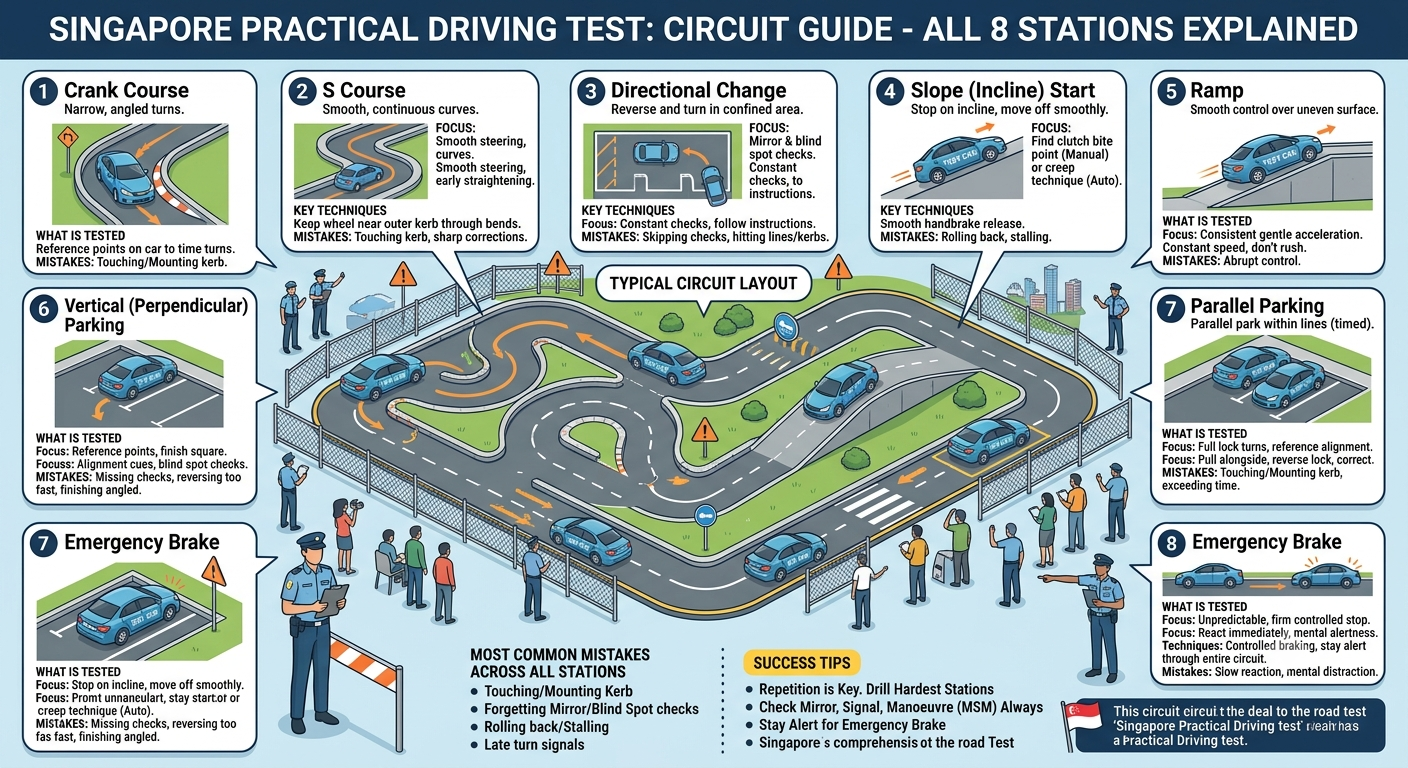
Singapore Practical Driving Test Circuit Guide: All 8 Stations Explained
Passing the BTT and FTT gets you to the starting line, not the finish line. Before you ever touch a public road on test day, you have to clear the circuit test, a controlled course inside your driving centre where an examiner scores you on eight specific manoeuvres. Fail badly enough at any one station and your test can end right there, before you even leave the circuit. Here is exactly what each station tests and how to avoid the mistakes that catch out most new candidates.
The 8 Circuit Stations
The exact order varies by centre and by test day, but every candidate faces the same eight stations:
- Crank course
- S course
- Directional change
- Slope (incline) start
- Ramp
- Vertical (perpendicular) parking
- Parallel parking
- Emergency brake
Crank Course
A narrow, angled path that tests how precisely you can steer through tight bends without touching either kerb. The trick most instructors teach is using a fixed reference point on your own car, such as where the door handle or a specific window line appears in relation to the kerb, to know exactly when to turn. Go slowly, since speed here only makes small steering errors harder to correct in time.
Need Help or Have Test Tips to Share?
Our official forum is now open! Ask questions about tricky BTT/FTT rules, share your driving test experiences, or help fellow learners pass on their first try.
S Course
A winding path, shaped like the letter S, marked by kerbs on both sides. This tests smooth, continuous steering rather than sharp corrections. Common advice is to keep your wheel closer to the outer kerb through each bend and straighten out early before the next curve, rather than cutting each turn as tightly as possible.
Directional Change
You reverse and manoeuvre to change the direction your car is facing within a marked area, without touching the boundary lines or kerbs. This station leans heavily on your mirror and blind spot checks, since you are moving backward through much of it. Some test centres mark this as a one way section, which can mean you need to take a later, sharper turn than feels natural, so it is worth confirming this detail with your instructor before test day.
Slope (Incline) Start
You stop on an incline, then move off again without rolling backward. This is one of the stations where nervous hesitation causes more failures than actual lack of skill. For manual transmission, find the clutch bite point, then release the handbrake smoothly as you feel the car wanting to move forward. For automatic transmission, a gentle footbrake to accelerator transition (sometimes taught as a creep technique) achieves the same result. Practise this one until it is mechanical, since freezing under pressure here is a common and avoidable mistake.
Ramp
Similar in spirit to the slope station but tests smooth control over a raised or uneven surface rather than just an incline stop and start. Consistent, gentle acceleration matters more than speed here.
Vertical (Perpendicular) Parking
You reverse your car into a marked bay, finishing squarely within the lines without touching them. Reference points are everything here: your instructor will usually teach you a specific moment (a mirror alignment, a line crossing a particular part of your car) to begin turning the wheel. Common mistakes include reversing too quickly, skipping blind spot checks, or finishing at a noticeable angle instead of squarely within the bay.
Parallel Parking
Often the most feared station, and usually done within a time limit (commonly cited as around 5 minutes). The general technique involves pulling up alongside the space, then reversing with full lock in one direction until your reference point aligns, straightening briefly, then completing the turn into the bay. Kerb touches cost demerit points, and mounting the kerb entirely can mean an immediate fail at this station. Consistent practice with the same reference points your instructor teaches you matters far more than trying to improvise your own method on test day.
Emergency Brake
This one catches people off guard specifically because it is unpredictable. Your examiner can trigger it at any point during the circuit, not just at a fixed station, and expects a firm, controlled stop the moment it is called. The mistake to avoid is not technical, it is mental: candidates who are still thinking about the previous station sometimes react a beat too slowly. Stay alert through the entire circuit, not just at the manoeuvres you know are coming.
The Most Common Mistakes Across All Stations
- Touching or mounting a kerb during parking, the crank, or the S course. This is the single most common source of lost marks across the whole circuit.
- Forgetting to readjust mirrors after a parking manoeuvre, which can cost marks even if the parking itself was clean.
- Rolling back or stalling on the slope, usually from releasing the clutch or handbrake too abruptly.
- Skipping or rushing blind spot checks, especially during reversing manoeuvres where examiners are watching closely for this specific habit.
- Late or missed turn signals heading into or out of a station.
How to Actually Prepare
Reading about the stations helps you know what is coming, but this part of the test is won through repetition, not theory. A few things that consistently help candidates:
- Ask your instructor to point out your driving centre's own specific circuit layout and any quirks (one way sections, tight spots) unique to that centre.
- Drill the stations you find hardest more than the ones you have already got comfortable with, rather than spreading practice evenly.
- Practise your mirror, signal, manoeuvre habit until it is automatic, since examiners are trained to notice when it is being performed for show rather than genuinely checked.
- Treat the emergency brake as a real possibility on every single run through the circuit, not just something to remember once you reach a specific point.
Once You Clear the Circuit
The circuit is only the first half of the Practical Driving Test. Passing it means moving on to the road segment, where an examiner assesses your driving in real traffic around your test centre. The circuit stations are fully within your control since they are the same every time, which makes them the part of the test most worth over preparing for before you even think about the unpredictability of the open road.
Keep Your Theory Sharp While You Drill the Circuit
Circuit practice and theory revision often overlap more than candidates expect, since road rules you learned for the FTT (like safe following distances and hazard awareness) apply directly once you move from the circuit to the road segment. If it has been a while since you last reviewed FTT material, it is worth a quick refresh before your test date rather than relying purely on circuit muscle memory.
Once your circuit skills feel solid, put your theory knowledge to the same kind of test with our Exam Simulation Mode, a timed fifty question mock exam that mirrors the actual BTT and FTT format.