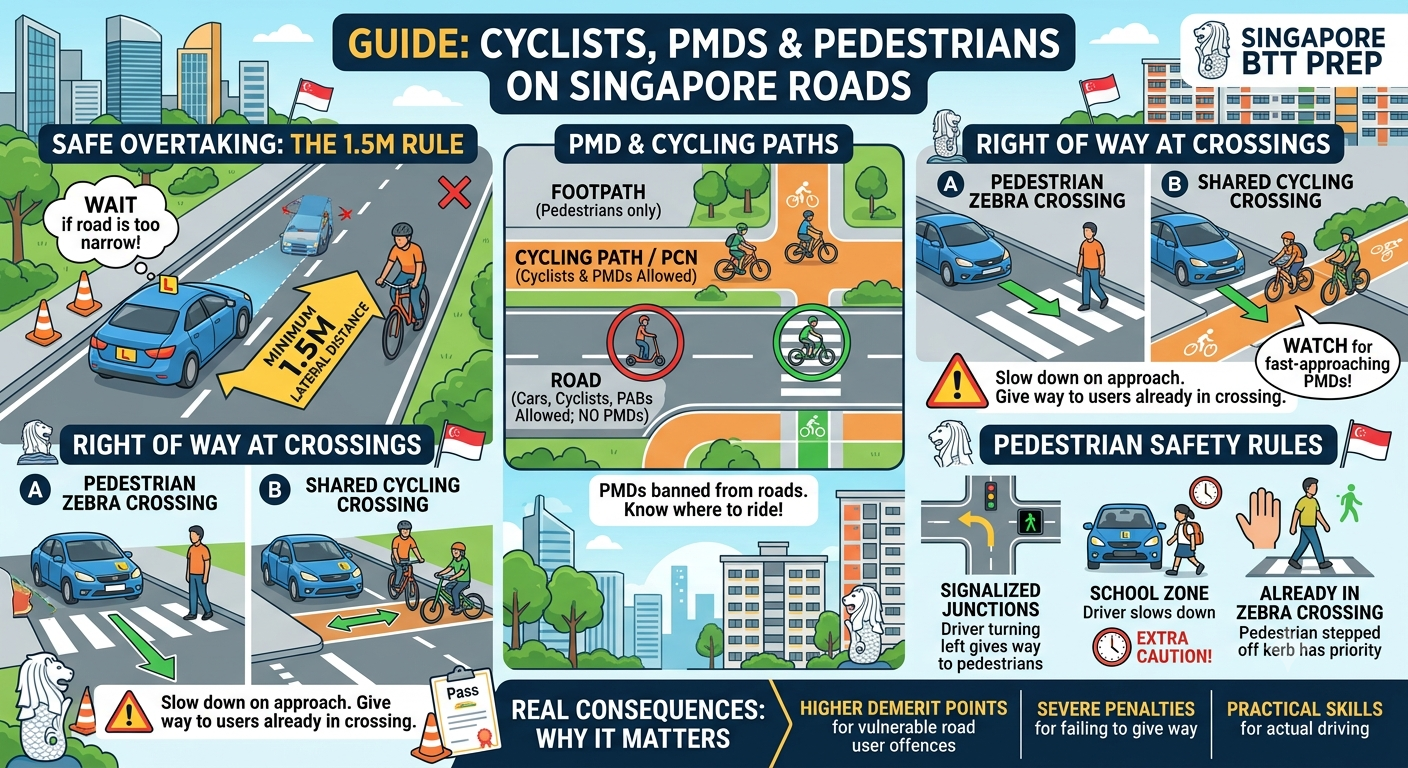
Cyclists, PMDs and Pedestrians: Singapore BTT Guide
Our Cyclists / PMD / Pedestrian category is one that trips up more learners than they expect, mostly because it isn't about memorising a single sign or number. It's about judgement: knowing who has right of way, how much space the law actually requires you to give, and which of these rules carry fines heavy enough to matter well after you've passed the BTT.
With cycling paths, Park Connectors, and PMD usage all more common on Singapore roads than they were a few years ago, this category has only grown more relevant on both the exam and the road. Here's what to actually know.
The 1.5 Metre Rule
When overtaking a cyclist, drivers are required to leave a minimum of 1.5 metres of lateral clearance. This applies on all roads, not just cycling paths or park connector crossings. If the road is too narrow to give 1.5m without crossing into the opposite lane, the correct move is to slow down and wait for a safe gap rather than squeeze past.
Need Help or Have Test Tips to Share?
Our official forum is now open! Ask questions about tricky BTT/FTT rules, share your driving test experiences, or help fellow learners pass on their first try.
This is a frequently tested BTT scenario: a question describes a narrow two lane road with a cyclist ahead and asks what the driver should do. The "safe but slower" answer is almost always correct over anything involving a quick overtake.
Where PMDs Are Allowed
Since the 2020 regulatory changes, Personal Mobility Devices (PMDs, such as e-scooters) are not allowed on roads in Singapore. They're restricted to cycling paths and Park Connector Network (PCN) paths, not footpaths or carriageways. As a driver, this means you generally won't encounter a PMD sharing your lane, but you will encounter them crossing at junctions where a cycling path intersects a road, and at these crossings the give way rules matter.
Power assisted bicycles (PABs) sit in a different category and do have limited road access, which is part of why this topic confuses learners. Cyclists, PABs, and PMDs are not all governed by the same set of road rules, even though they look similar at a glance.
Right of Way at Shared Crossings
Where a cycling path or PCN crosses a road at a marked crossing, cyclists and PMD users generally have right of way once they've already entered the crossing, the same logic that applies to pedestrian crossings. Drivers are expected to slow down on approach to any marked crossing point, not just when someone is visibly already on it, since PMDs in particular can approach faster and less predictably than a pedestrian on foot.
A common mistake in practice, and a trap in BTT questions, is treating a cycling path crossing the same as an unmarked junction, where normal vehicle priority rules would apply. They aren't the same, and the exam will test the distinction directly.
Pedestrians: Beyond the Basic Crossing Rule
Most learners know that pedestrians have priority at a zebra crossing. Fewer are confident on the edge cases that actually come up in BTT scenarios:
- At a signalised crossing, a driver turning left or right on a green light must still give way to pedestrians who are legally crossing on their own green man.
- Near schools, hospitals, and other zones with reduced speed limits, the expected standard of caution is higher even where no pedestrian is currently visible.
- A pedestrian who has already stepped off the kerb onto a zebra crossing has priority even if a vehicle was already approaching, since the vehicle is expected to have anticipated and slowed.
Why This Category Carries Real Consequences
Offences involving cyclists and pedestrians tend to sit at the higher end of the demerit point scale, precisely because the harm potential is higher than a typical moving violation. Failing to give way to a pedestrian at a crossing, for example, is treated far more seriously than many drivers assume before they've looked at the actual penalty schedule. This is a category where "I didn't think it was that serious" is one of the more common and costly misconceptions among new drivers.
Study Tips for This Category
- Don't just memorise the 1.5m figure. Practice recognising which BTT scenario images show a road too narrow for a safe overtake.
- Separate PMD rules from cyclist rules in your head. They are tested as distinct topics even when a question's illustration makes them look similar.
- Pay attention to wording like "has already entered" versus "is approaching" in crossing priority questions, since the correct answer often hinges on that distinction.
- Treat school zone and reduced speed zone questions as their own mini category rather than folding them into general pedestrian rules.
Getting comfortable with this category isn't just exam prep. It's one of the more directly practical parts of the BTT syllabus, since road sharing situations like these come up on almost every drive once you're licensed. Once you've cleared the theory stage, these same judgement calls resurface on the road, including at several stations of the practical test, so it's worth reading our circuit test stations guide to see how they carry over.