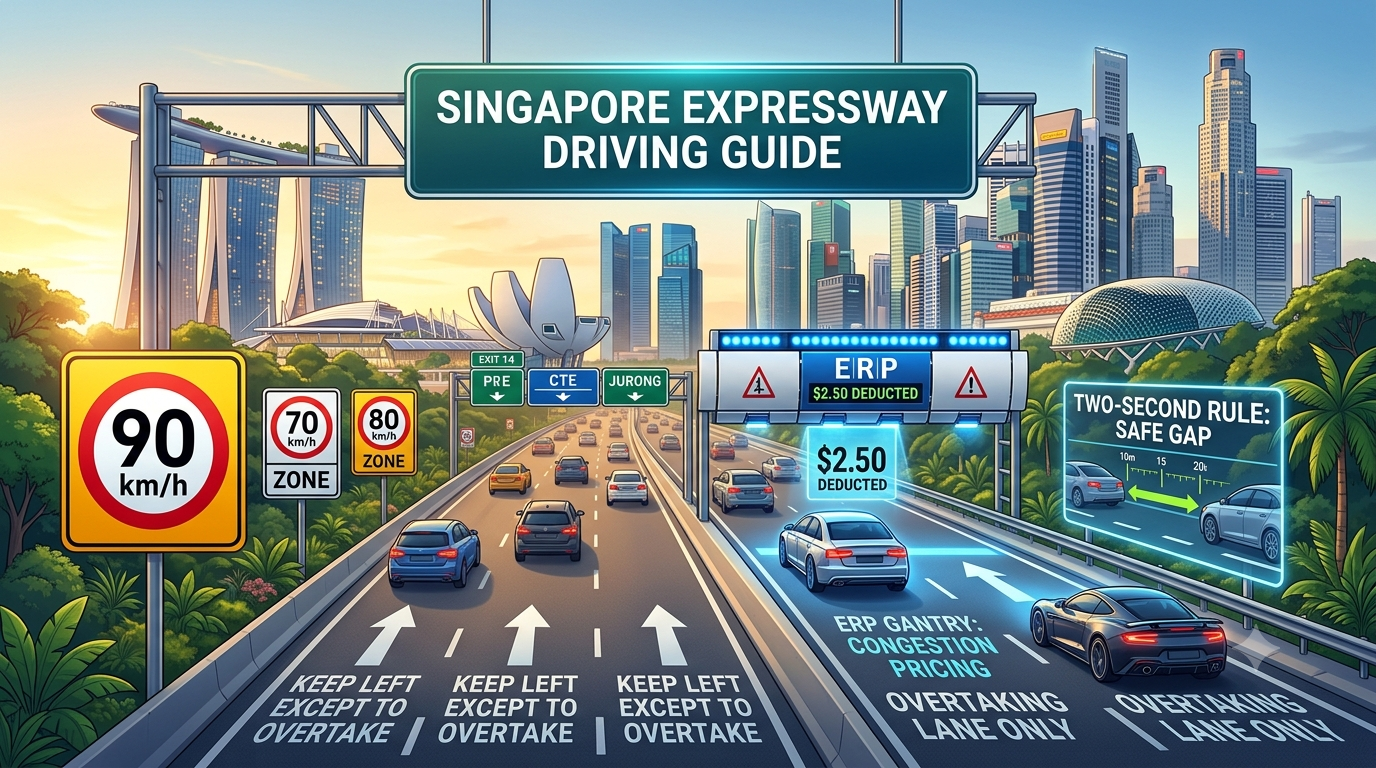
Expressway Driving in Singapore: Speed Limits, Lane Rules and ERP Basics
Expressways feel like a different world compared to regular roads, higher speeds, longer stretches without traffic lights, and rules that punish hesitation more than they punish decisiveness. Most new drivers get their first real expressway experience only after passing their test, which makes understanding the rules beforehand even more important, both for the FTT and for the actual driving.
Speed Limits on Expressways
Unless a specific sign states otherwise, the default speed limit on Singapore expressways is 90 kilometres per hour, though several stretches carry a lower posted limit, commonly 70 or 80 kilometres per hour, due to road geometry or nearby residential areas. Speed limit signs on expressways override the general default wherever they appear, so drivers are expected to follow the posted number rather than assume the standard limit applies everywhere.
Lane Discipline
Expressways in Singapore generally follow a keep left except to overtake principle. The rightmost lane is meant for overtaking rather than continuous cruising, and lingering there without actively overtaking is both discouraged and, on certain stretches, enforced through camera monitoring.
Need Help or Have Test Tips to Share?
Our official forum is now open! Ask questions about tricky BTT/FTT rules, share your driving test experiences, or help fellow learners pass on their first try.
- Move back to a left or middle lane once you've completed an overtaking manoeuvre.
- Signal early when changing lanes, since expressway speeds leave other drivers less time to react than on a normal road.
- Avoid weaving between lanes to gain small amounts of distance, a common cause of accidents at higher speeds.
Merging and Slip Roads
When joining an expressway from a slip road, the responsibility to merge safely sits with the joining vehicle rather than existing expressway traffic needing to make way. Match your speed to the flow of traffic before merging rather than joining slowly and forcing following vehicles to brake. Similarly, when exiting, move into the correct lane well ahead of your exit rather than cutting across multiple lanes at the last moment.
What ERP Actually Is
Electronic Road Pricing, or ERP, is Singapore's system for congestion charging on expressways and selected roads during peak hours. Gantries positioned along these routes automatically deduct a fee from an in vehicle unit as you pass, with the rate varying depending on the specific gantry, time of day, and current congestion levels. There's no need to slow down for a working gantry, deduction happens automatically at normal driving speed, and slowing down unnecessarily near a gantry is itself a hazard to traffic behind you.
Following Distance at Higher Speeds
The stopping distance required at expressway speeds is significantly longer than on regular roads, yet many new drivers instinctively keep the same following gap they use in town. A commonly taught guideline is the two second rule, picking a fixed point ahead and ensuring at least two seconds pass between the vehicle in front reaching it and your own vehicle reaching the same point, extending this to three or four seconds in wet weather or heavy traffic.
What to Do If Something Goes Wrong
- If your vehicle breaks down, move as far onto the road shoulder as possible and switch on your hazard lights immediately.
- Set up a warning triangle behind your vehicle if you have one and it's safe to do so.
- Exit the vehicle from the side away from traffic and wait behind the barrier rather than beside the car.
- Contact the relevant road assistance service or the Traffic Police rather than attempting repairs on a live expressway shoulder.
Why Expressway Questions Trip Up New Drivers
The FTT tests expressway scenarios specifically because the consequences of a mistake scale up so quickly at higher speeds. Questions often combine two concepts at once, for example lane discipline together with merging, so it helps to understand each rule individually rather than memorising isolated facts that don't transfer well to a slightly different scenario on test day.
The Basic Theory Test SG app includes a dedicated expressway and high speed driving category, letting you practice these combined scenarios repeatedly until the logic becomes automatic.
If you haven't already, check out our previous article on parking rules in Singapore, since many of the same line and signage principles carry over once you exit the expressway into regular roads.