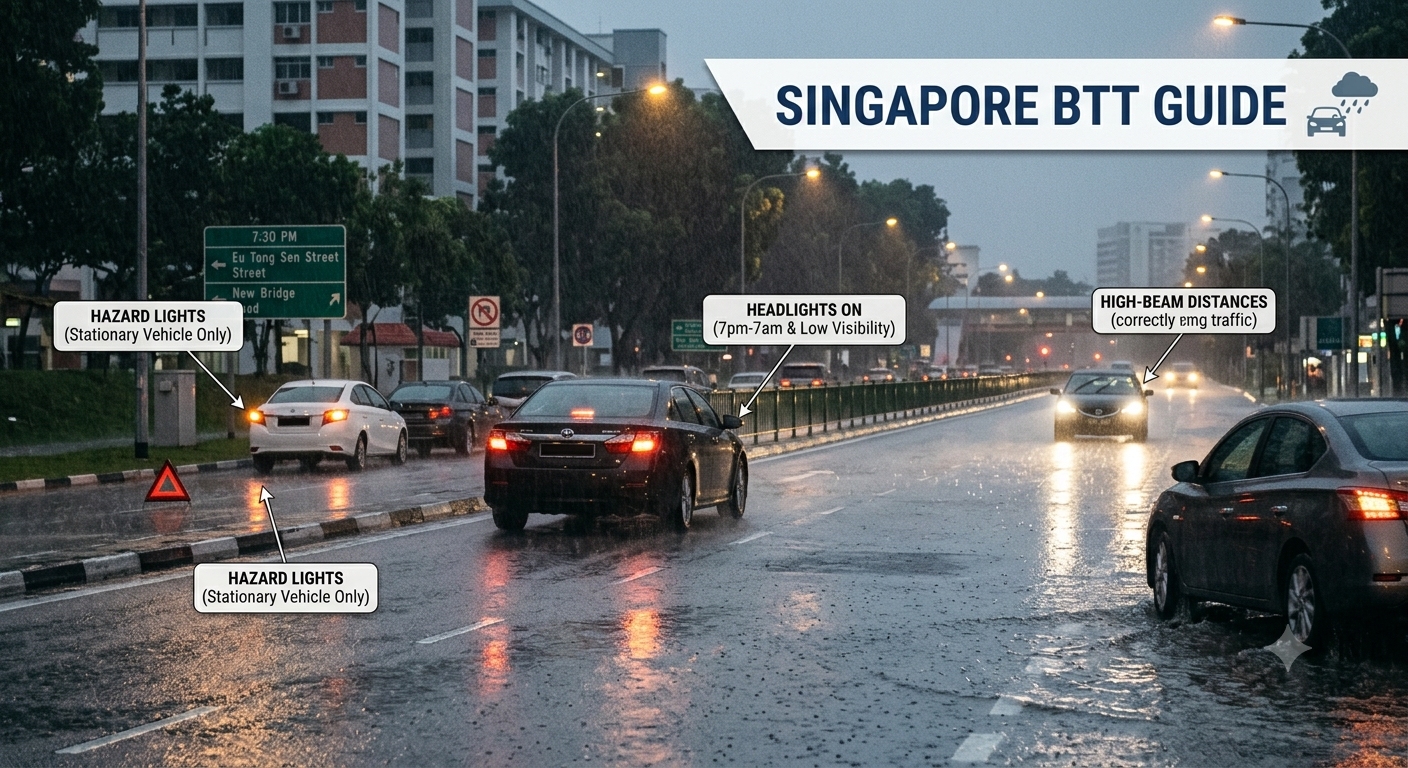
Headlights and Flood Driving Rules: Singapore BTT Guide
Our Flood and Headlights category groups two topics that share one theme: staying visible and in control when conditions turn against you. Singapore's tropical climate means sudden downpours and flash floods are a regular part of driving here, and the BTT tests whether you know the correct response rather than just common habits picked up from other drivers.
When You Must Switch On Your Headlights
The rule tested here has two parts, and missing the second part is a common mistake:
- Headlights must be switched on from 7:00pm to 7:00am, every day, regardless of how bright the streetlights are.
- Headlights must also be switched on any time visibility is reduced, such as during heavy rain, fog, or haze, even in the middle of the day.
This second condition is the one BTT questions like to test with a scenario: a driver is on the road at 2pm during a sudden downpour and does not think headlights are needed since it is daytime. The correct answer is that headlights should go on immediately, because the rule is based on visibility, not the clock.
Need Help or Have Test Tips to Share?
Our official forum is now open! Ask questions about tricky BTT/FTT rules, share your driving test experiences, or help fellow learners pass on their first try.
Dipping Your High Beams
High beam use is tested with a specific distance figure worth remembering: you must dip your high beams to low beam when you are within 150 metres of an oncoming vehicle, or when following another vehicle within 150 metres. Failing to dip is treated as an offence, since a high beam at close range can dazzle the other driver and cause a genuinely dangerous situation, not just an inconvenience.
Hazard Lights: What They Are Actually For
This is where a lot of real world habits conflict directly with the correct answer. Many drivers switch on their hazard lights while driving through heavy rain, assuming it makes them more visible. The Traffic Police and Land Transport Authority guidance is clear that this is the wrong response:
- Hazard lights are meant to warn others of a stationary or broken down vehicle, or a genuine emergency, not a moving car in bad weather.
- Using hazard lights while still driving makes your turn signals indistinguishable, since both indicators flash together. Other drivers cannot tell if you are changing lanes.
- The correct response to reduced visibility in rain is simply to switch on your headlights (and tail lights), not your hazard lights.
If you do break down or need to stop, that is exactly when hazard lights belong: switch them on immediately, and if you can do so safely, place a warning triangle a reasonable distance behind your vehicle to alert approaching traffic.
Fog Lights
Fog lights follow a similar principle to hazard lights: they exist for one specific situation and should not be left on outside it. Use them only when visibility is severely reduced by fog, mist, or very heavy rain, and switch them off as soon as conditions improve, since they can dazzle other drivers in normal visibility the same way an undipped high beam can.
Driving Through Flooded Roads
Flash floods can build up quickly during a heavy downpour, and the BTT tests judgement here as much as any specific rule:
- Reduce your speed well before you reach standing water, since driving too fast through it risks hydroplaning, where your tyres lose contact with the road surface and you lose steering control.
- If you are aware of a road section that floods often, take an alternative route rather than risking it, even if that route is longer.
- Increase your following distance in heavy rain, since wet roads extend your stopping distance considerably compared to dry conditions.
- Avoid harsh braking. Ease off the accelerator earlier than usual, then brake gently, rather than braking hard at the last moment.
Why This Category Trips Up Confident Drivers
Unlike categories built on numbers or diagrams, this one often catches people who already have real world driving habits, because some of those habits (like hazard lights in rain) are common on the road despite being the wrong answer on the test. When a question describes a rainy driving scenario, focus on what the handbook actually specifies rather than what you have seen other drivers do around you.
Practise This Category Free
You can run the Flood and Headlights category as many times as you need, with instant review of every question you get wrong so you know exactly what to revisit.
Once you have this category down, put your knowledge to a real test with our Exam Simulation Mode, a timed fifty question mock exam that mirrors the actual BTT and FTT format.
Good visibility means little without good judgement at the junction itself, so it's worth reviewing our guide on right of way at junctions and roundabouts as well.