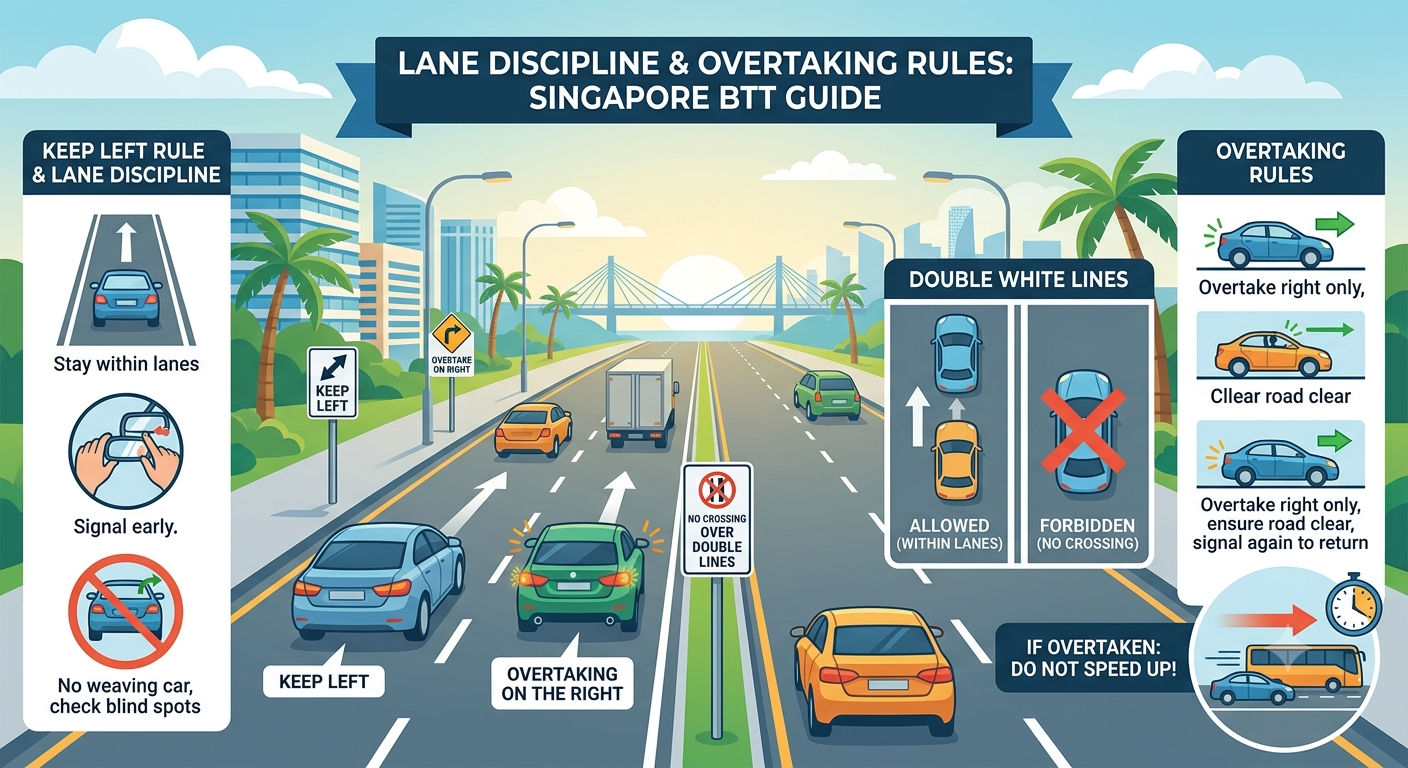
Lane Discipline and Overtaking Rules: Singapore BTT Guide
Our Lane Discipline and Overtakings category is one of the more practical sets in the BTT question bank, because these are rules you will actually apply on almost every drive you ever take. The official Traffic Police handbook groups this topic under three related ideas: the Keep Left Rule, Lane Discipline, and Overtaking, and the BTT tests all three together.
The Keep Left Rule
Singapore drives on the left, and the rule tested here is simple in theory but easy to get wrong in practice: you should keep to the left side of the road, and only move to the right (or into a right hand lane) when you actually need to overtake or turn right. Sitting in a right hand lane for long stretches without overtaking anyone is what the handbook calls road hogging, and it is treated as a real offence, not just poor manners.
What Lane Discipline Actually Means
Lane discipline covers how you behave once you are in a lane, not just which lane you choose:
Need Help or Have Test Tips to Share?
Our official forum is now open! Ask questions about tricky BTT/FTT rules, share your driving test experiences, or help fellow learners pass on their first try.
- Stay within your lane markings, and only change lanes when it is genuinely necessary.
- Signal clearly before changing lanes, and check your mirrors and blind spot every time.
- Avoid weaving between lanes to gain small amounts of time in traffic.
- On a multi lane road, position yourself in the centre of your lane rather than drifting toward either edge.
A common BTT trap is a question describing a driver who keeps switching lanes to move ahead in slow traffic. The correct answer almost always points to staying in one lane and being patient, since frequent lane changes increase collision risk without meaningfully saving time.
Overtaking: The Core Rules
Overtaking questions tend to describe a specific road situation and ask whether it is safe or legal to overtake. The underlying rules to know:
- You may only overtake on the right, except in specific situations such as when a vehicle ahead is signalling to turn right and there is enough room to pass safely on the left.
- Never overtake near a pedestrian crossing, a road junction, a street corner, or a sharp bend, since visibility and reaction time are reduced in all of these situations.
- Check that the road ahead is clear far enough for you to complete the overtaking manoeuvre and return to your lane safely before you begin.
- Signal your intention clearly before pulling out, and signal again before returning to your original lane.
Double White Lines: What They Actually Restrict
Continuous double white lines in the centre of the road are one of the most tested markings in this category, and the rule has a detail many learners miss:
You are not allowed to cross double white lines to overtake. However, if the road is wide enough to have two lanes travelling in the same direction on your side, you can still overtake another vehicle within your own side of the road, as long as you never cross over into the opposing lane. The line itself is what you must never cross, not overtaking in general.
U turns and right turns are also not permitted anywhere double white lines are marked, since crossing them briefly to turn would break the same rule that prevents overtaking across them.
If Someone Is Overtaking You
This is a scenario style question that catches learners who have only memorised the overtaking rules from the overtaking driver's point of view. If another vehicle is overtaking you, the correct response is to maintain your speed or slow down slightly to give them room, never speed up. Speeding up while being overtaken, especially by a bus or a heavy commercial vehicle, is treated as dangerous and inconsiderate driving by the handbook.
Why This Category Feels More Intuitive Than Others
Unlike categories built around memorising specific numbers or signal sequences, Lane Discipline and Overtakings rewards understanding a single underlying idea: minimise unnecessary lane changes, and only overtake when it is genuinely safe and legal to do so. Once that idea is solid, most questions in this category become a matter of applying common sense to the scenario described rather than recalling a rule from memory.
Practise This Category Free
You can run the Lane Discipline and Overtakings category as many times as you need, with instant review of every question you get wrong so you know exactly what to revisit.
Once this category feels solid, put it to the test under real exam pressure with our Exam Simulation Mode, a timed fifty question mock exam that mirrors the actual BTT and FTT format.